
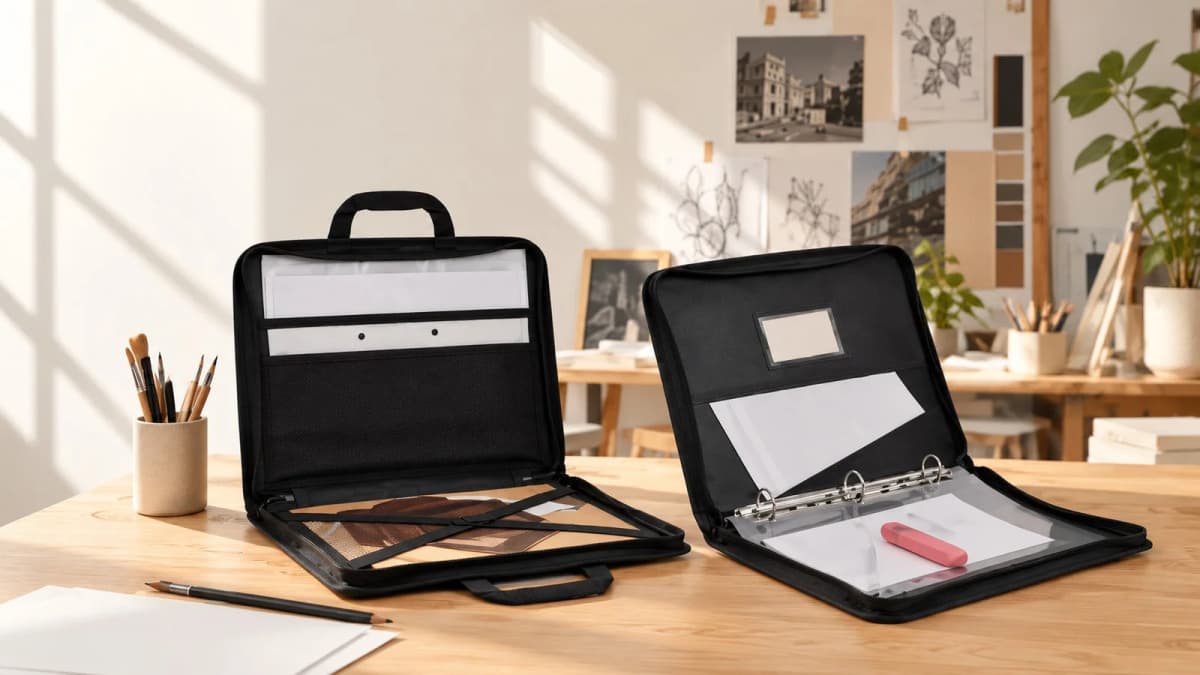
Distributors usually compare portfolio cases by size first: A4, A3, A2 or A1. Size tells you how big the case is, but not how the customer will use it. The closure does.
A zipper portfolio and a ring binder portfolio can look alike from the outside, yet they're built for different jobs. So the useful question isn't "which is better?" but "what will the end user do with what's inside?"
What's the core difference between a zipper and a ring binder portfolio?
A zipper portfolio carries and protects; a ring binder portfolio organises and presents. The difference shows up once the case is full.
Zipper portfolio. Loose drawings, boards and documents sit together inside the case. Once it's zipped, nothing slips out in transit. Students heading between home and school, artists carrying work to a studio, teachers moving class materials: all of them mainly need the work to arrive flat and complete.
Ring binder portfolio. Each piece sits in its own sleeve on the rings, so the portfolio works like a book. Users can add new work, take out older pieces, change the order or split work into sections. That suits anyone whose portfolio keeps changing.
How do the two compare side by side?
By use, the two formats split cleanly:
| Zipper drafting bag | Ring binder portfolio | |
|---|---|---|
| Main job | Carry and protect | Organise and present |
| Contents | Loose sheets, boards, documents | Pages in clear sleeves |
| Rearranging pages | Not designed for it | Easy |
| Daily transport | Strong | Good |
| Presenting work | Basic | Strong |
| Customer's question | "How do I carry this safely?" | "How do I show this clearly?" |
How do they compare on real A4 specs?
The ring binder case is larger and thicker, because the rings and sleeves need room. Here are the A4 sizes of our two Standard Series models, both in lightweight PP:
| A4 model | Outer size (mm) | Qty per carton | CBM per carton | Size range |
|---|---|---|---|---|
| Zipper Drafting Bag ZD-601 | 350 × 265 × 30 | 12 | 0.0412 | 6 sizes, A4 to A1 incl. B4, B3 |
| Ring Binder Portfolio RZD601 | 360 × 285 × 40 | 24 | 0.1040 | 4 sizes, A4 to A1 |
Two practical points for buyers. The ring binder is 10 mm deeper and a little larger all round, so allow for that in shelf space and freight. And if your market uses B sizes, only the zipper Standard Series offers B4 and B3.
When should a customer choose a zipper portfolio?
When the work mostly needs to travel. For many art students that's every day: drawings go from home to school, from classroom to studio, from one workshop to the next. The work doesn't need to be shown page by page; it needs to stay together and flat.
The zipped case keeps loose sheets from sliding out and handles large drawings that wouldn't fit neatly in a binder. Typical users are art, design and architecture students, illustrators, teachers and workshop participants. Position it as safe transport between locations.
For a step up from the PP Standard Series, see the Oxford fabric Zipper Drafting Bag Upgrade Series.
When should a customer choose a ring binder portfolio?
When the contents keep changing. A student applying to several schools may show different work at each interview: pull an old project, add a new one, change the order. With a ring binder, they change individual pages instead of rebuilding the whole portfolio.
The same flexibility helps outside the art classroom: design and sales presentations, product collections, school projects and reference files that are updated often. Here the portfolio is part of the presentation, not just the container. Position it as flexible pages for organised presentation.
For a more formal PU version, see the Ring Binder Portfolio Professional Series.
Should distributors stock both?
Usually, yes. The two formats don't compete; they cover two buying moments in the same customer's year.
A student may carry loose drawings in a zipper portfolio all semester, then move selected work into a ring binder for a final review. That's two purchases, each with a clear reason. Explaining it that way also saves customers from choosing between two cases that look similar on the shelf.
How should you position each one in your range?
Group by use as well as size. A shelf labelled only A4, A3, A2, A1 doesn't tell customers which case fits them.
- Carry & Protect (zipper): loose artwork, daily transport, school-to-home and studio-to-studio use.
- Organise & Present (ring binder): portfolio reviews, replaceable pages, structured displays, frequently updated content.
This also simplifies sales training. Staff can start with one question: "Will your customer mainly carry the work, or present it?" The answer usually points to the right product.
What should wholesale buyers consider?
- Who is the main customer? Art supply stores often sell more zipper cases to students; presentation and office suppliers may see more demand for ring binders; school suppliers usually need both.
- How often do the contents change? Rarely: a zipper case is enough. Often: a ring binder is worth it.
- Is it used mostly in transit or in presentations? Carried every day favours the zipper; opened and reviewed often favours the ring binder.
- Do you need an entry level and a presentation level? The two formats can sit at different positions in the range rather than compete on price. Our portfolio range guide shows one way to build it.
For MOQ, sampling and lead times, see A Wholesale Buyer's Guide to Sourcing Art Portfolio Cases.
Frequently Asked Questions
What is the main difference between a zipper portfolio and a ring binder portfolio?
A zipper portfolio is mainly for carrying and protecting loose artwork or documents. A ring binder portfolio is mainly for organising, rearranging and presenting individual pages.
Which type is better for students?
It depends on use. Students carrying loose drawings between home and school usually prefer a zipper portfolio; students preparing for portfolio reviews often prefer a ring binder.
Which portfolio is easier to update?
The ring binder. Pages can be added, removed or reordered without replacing the whole portfolio.
Is a ring binder portfolio bigger than a zipper portfolio of the same size?
Usually, yes. In our Standard Series, the A4 ring binder measures 360 × 285 × 40 mm against 350 × 265 × 30 mm for the A4 zipper bag, because the rings and sleeves need space.
Should distributors stock both?
For art, design, school or creative markets, usually yes. They cover different needs: carrying work every day, and presenting selected work.
Can zipper and ring binder portfolios be customised?
Yes, on OEM orders: size, material, colour, inside layout, branding and packaging. Sampling is recommended before bulk production, and OEM MOQ is 500 pcs per style and size.
Key takeaways
- The closure decides the job: zipper for carrying, ring binder for presenting.
- At A4, the ring binder case is larger and 10 mm deeper; plan shelf space and freight accordingly.
- Only the zipper Standard Series covers B4 and B3.
- Stock both and position them by use: Carry & Protect, Organise & Present.
See the Zipper Drafting Bag and Ring Binder Portfolio Standard Series, or send us your requirements. Related: How to Store and Protect an Art Portfolio Between Uses.