
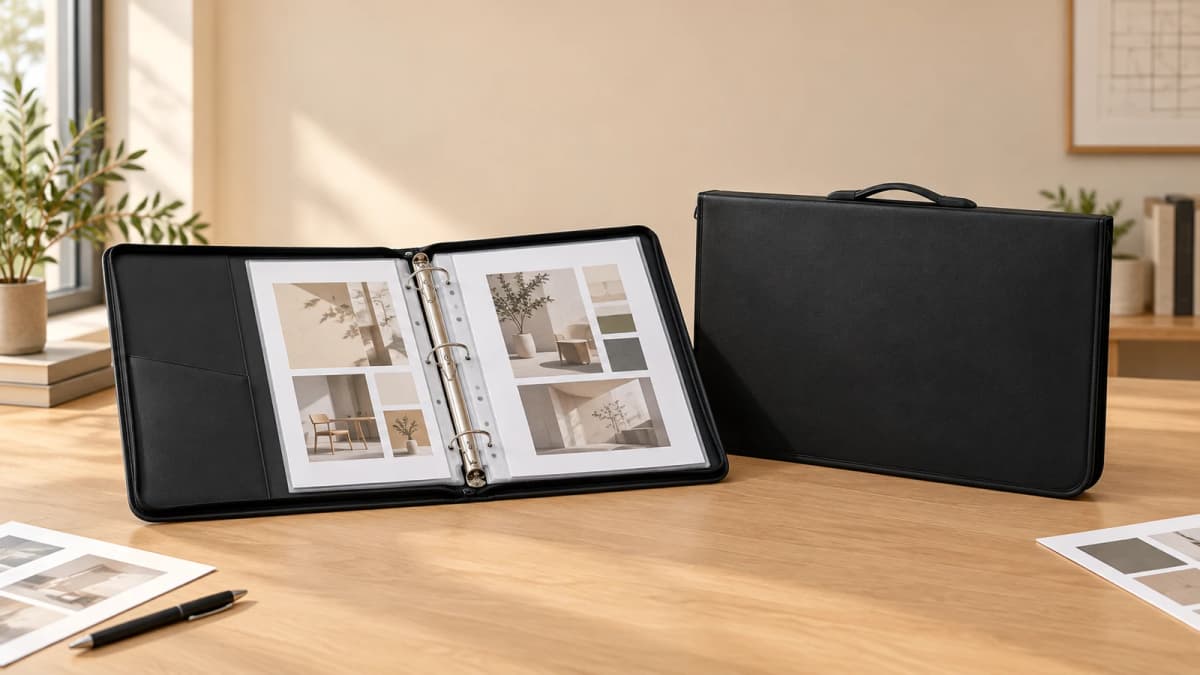
A folder stores paper. A ring binder portfolio stores it, keeps it in order, and shows it the moment the case opens in front of a tutor, a client or an admissions panel.
This guide is for art stores, school suppliers and stationery retailers looking at the Professional Series: what it's for, which sizes to stock, what to check on a sample, and what can be customised.
What is a ring binder portfolio for?
It's for presenting work in person. The rings hold clear sleeves like pages in a book, so a portfolio can be flipped through, and pages can be added, removed or reordered as the work changes.
That matters because a portfolio is never finished. A new project comes in, an older piece comes out, and the running order changes the night before a review. A fixed-page book can't follow those changes; a ring binder can.
Do students and designers still need a physical portfolio?
Often, yes. Most applications now start online, but interviews, portfolio reviews and client meetings still regularly involve printed work on the table.
Printed work also shows paper texture, scale and print quality that a screen flattens. For students heading into reviews and designers meeting clients, a case that keeps sheets clean and in order is still part of the kit.
Which size fits which customer?
The Professional Series comes in four A sizes. Specifications below are from the product page.
| Item no. | Size | Dimensions (mm) | Qty per box | CBM |
|---|---|---|---|---|
| RSPU6013 | A4 | 360 × 285 × 40 | 12 | 0.1040 |
| RSPU6033 | A3 | 480 × 350 × 40 | 12 | 0.1615 |
| RSPU6056 | A2 | 680 × 495 × 40 | 6 | 0.1610 |
| RSPU6069 | A1 | 940 × 665 × 40 | 6 | 0.2848 |

A1: presentation boards and large work
Mounted prints, presentation boards and architecture sheets. For art and design students whose work doesn't come smaller.
A2: coursework
Still holds illustration boards and design layouts, and is much easier to carry every day than A1.
A3: portfolio reviews
Big enough to show work clearly, small enough to carry into an interview room. A good anchor size for a "portfolio review" display.
A4: documents and smaller work
Certificates, printed handouts, smaller artwork and references. The easiest first purchase, and a natural entry point to the range.
What's inside the case?
The PU shell protects the work in transit. The inside is what makes the case useful day to day.

- Ring binder: add, remove and reorder pages as the portfolio changes.
- Clear sleeves: keep dust, fingerprints and handling marks off the work while it stays visible.
- Document pocket: room for what isn't artwork, such as a CV, application form, certificate or notes.
- Reinforced carry handle: for carrying the case between home, school and meetings.
Ring binder or zipper drafting bag: which should you stock?
Stock ring binders for presenting work and zipper drafting bags for carrying loose sheets. They answer different needs, so many art stores carry both.
- Ring binder portfolio: work is shown page by page in sleeves and reordered often. Best for reviews, interviews and client meetings.
- Zipper drafting bag: loose sheets, boards and drawings are carried flat and taken out to use. Best for daily carrying to class or the studio.
For a deeper comparison, see Zipper vs. Ring Binder Portfolio.
How should art stores and school suppliers sell it?
Present it as a presentation case for reviews and interviews, not as general storage. That's what customers are buying it for.
- Art supply stores: place it with sketchbooks, drawing paper and presentation books in a "portfolio essentials" section, rather than in a general storage aisle.
- School and institutional suppliers: offer it to art departments, design programs and continuing-education courses that order supplies once or twice a year. One catalog page covers A1 to A4.
- Stationery retailers: A3 and A4 work as presentation and document tools for students and professionals, not only for artists.
What should buyers check before ordering?
Five things decide whether this case gets reordered. Check them on a sample loaded with real work:
- Exterior and handle attachment: the PU finish, seams, and especially where the handle meets the body, which takes the most strain.
- Ring mechanism: it should open and close smoothly and stay aligned with a full set of sleeves.
- Sleeve count and thickness: decide what your customers need. Thicker sleeves feel better but cost more, so settle this before the first order.
- Handle on A1 and A2: a large case full of boards is heavy. Lift a loaded sample several times.
- Retail packaging: size and dimensions should be visible on the shelf, so customers can tell A2 from A3 without asking.
For sampling, lead times and payment terms, see our wholesale buyer's guide.
What can be customised on an OEM order?
Most of the case can be adapted for private label. OEM MOQ is 500 pcs per style and size.
- Size range: one size or the full A1–A4 run. Specialist art retailers usually want the full range; general stationery can start with A3 and A4.
- Interior: ring type, sleeve count, pocket layout and lining can be matched to the target customer.
- Colour and finish: black is the standard; other colours can be specified on OEM orders.
- Branding and packaging: logo printing or debossing, hang tags and retail packaging.
More on what can change: OEM & Custom.
Frequently Asked Questions
What sizes does the Professional Series come in?
A4, A3, A2 and A1. Item numbers and dimensions are listed on the product page.
What's the difference between a ring binder portfolio and a portfolio bag?
A portfolio bag carries flat work. A ring binder portfolio adds rings, clear sleeves and a document pocket, so it also organises and displays the work.
Can the interior be customised for wholesale orders?
Yes, on OEM orders. Ring type, sleeve count, pocket layout and lining can be adjusted. OEM MOQ is 500 pcs per style and size.
Can it be made in other colours?
Black is the standard. Other colours can be specified on OEM orders.
How many clear sleeves should a portfolio include?
It depends on the customer. Budget-focused ranges use fewer sleeves; professional users want more capacity. Confirm both the count and the sleeve thickness before ordering, since both affect quality and unit cost.
Who usually stocks ring binder portfolios?
Art supply stores, school and institutional suppliers, and stationery retailers.
Key takeaways
The Professional Series is a presentation case first: pages can be reordered, work stays visible in sleeves, and the PU shell keeps it presentable.
- Four A sizes, A4 to A1, on one design.
- Stock it for reviews and interviews; pair it with a zipper drafting bag for daily carrying.
- Test a loaded sample: rings, handle and sleeves decide reorders.
- Interior, colour and branding can be customised from 500 pcs per style and size.
See the Ring Binder Portfolio Professional Series, or send us your requirements for a quote.