
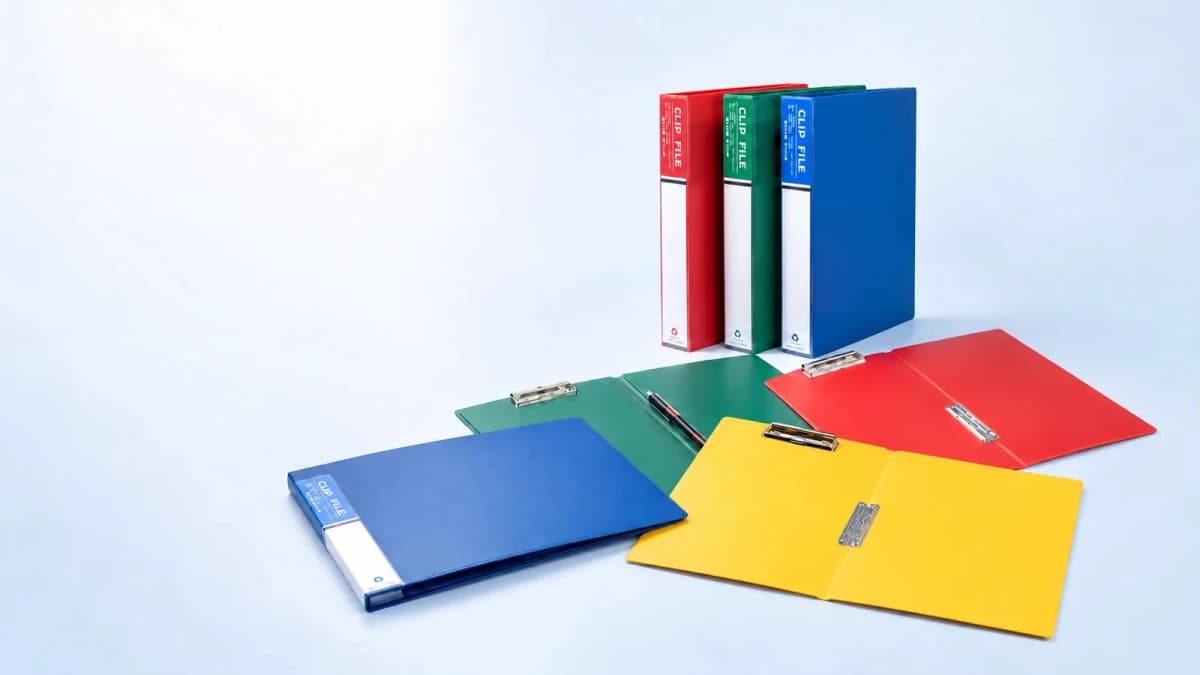
Before laptops, tablets and cloud storage, paper was the centre of business, education and communication. Offices ran on printed reports, contracts, quotations and catalogues. Schools ran on handouts, worksheets and student records. Salespeople carried brochures and price lists on every customer visit.
Almost every industry needed a simple, reliable way to handle all that paper. That's when file folders and clip files became everyday essentials, and two of the products our family factory grew up making. (Previous chapter: when file folders became mainstream.)
What job did file folders do?
They sorted documents and kept them in order, by subject, customer, department, class, project or date. There was no searching for a file name on a computer. Papers that weren't sorted got lost, mixed up or damaged.
So the folder wasn't optional. Companies, teachers, students, banks, government offices, training centres and stationery shops all bought them. A simple product with a very wide market.
Why did clip files catch on?
Because they solved a different problem: holding papers firmly while they're in use. A clip file grips loose sheets without punching holes or binding, so it suits documents that come and go, such as meeting notes, application forms, reports, class materials and sales sheets.
- Office workers carried documents into meetings on them.
- Teachers kept handouts and class records together.
- Salespeople presented product sheets and quotations.
- Students kept loose papers from scattering.
When paper moved constantly between desks, classrooms and customers, a clip file was about as practical as a product could be.
File folder or clip file: what's the difference?
| File folder | Clip file | |
|---|---|---|
| Main job | Sort and store | Hold, carry and present |
| How papers are held | Loose inside, or by snap or string closure | Gripped under a metal clip |
| Typical use | Records, archives, class subjects | Meetings, forms, sales visits, handouts |
| Time frame | Long-term | Day-to-day, temporary |
Why did these products sell so well?
Because they matched how people worked. Printed paper carried most communication, so filing products were part of the daily routine, not an extra. They were easy for shops to display, easy for customers to understand, and bought again and again. That combination is what makes a product category last.
The folders themselves kept changing as customers asked for more, from plain side labels to hot stamping and full-colour printing. That part of the story has its own chapter: from side labels to full-colour printing.
What did making them teach us?
A lot about how people really handle documents. We learned how material thickness affects durability, how a clip has to sit so it grips without tearing paper, and how cutting, folding, printing and finishing decide whether a product feels right in daily use.
The same lessons carried into refill pages, presentation books and, later, portfolio cases such as our ring binder portfolios and zipper drafting bags. The shapes changed. The job (organise it, protect it, present it clearly) didn't.
Frequently Asked Questions
Why were file folders and clip files such strong sellers before digital storage?
Paper was the main way information moved, and both products solved the same problem, keeping it organised and protected, cheaply and reliably.
What's the difference between a file folder and a clip file?
A file folder sorts and stores documents for the long term. A clip file holds loose sheets firmly under a clip for day-to-day use, such as meetings, forms and presentations, without punching or binding.
How did these products lead to portfolio cases and presentation books?
The manufacturing skills carried over: material choice, cutting, finishing and how paper is held. Customers also wanted more structured, presentable storage, which led to display books, presentation books and eventually portfolio cases for artwork.
Are filing products still relevant today?
Yes. Schools, offices and training centres still print materials and still need practical ways to organise and present them alongside digital tools.
Can storage products be customised for wholesale or private-label orders?
Yes. Printing, colours, sizes and packaging can be customised on OEM orders. OEM MOQ is 500 pcs per style and size.
Looking ahead
Digital tools are everywhere now, but schools still print, offices still store and companies still need folders for meetings and events. The way people work changed; the need to keep paper in order didn't. Next chapter: from file folders to refill pages. Or start at the beginning: our manufacturing roots since 1976.
Looking for storage or presentation products for your market? See the catalogue, OEM & Custom, or send us your requirements.