
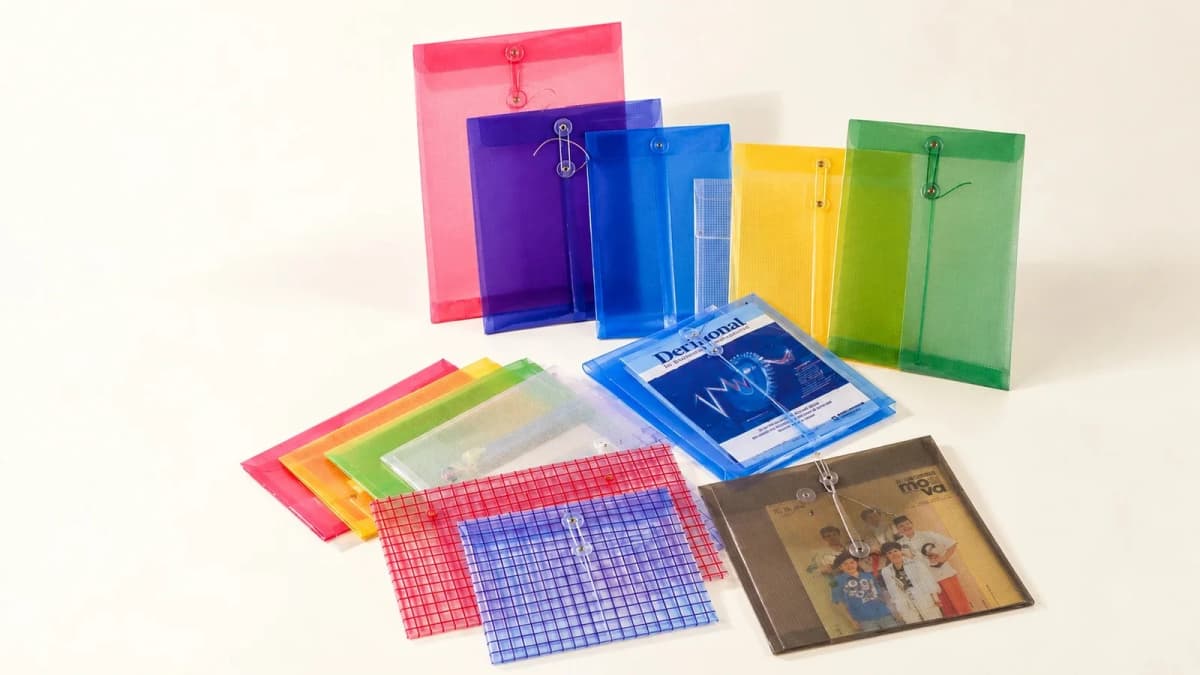
There was a time when a file folder wasn't a minor line in a stationery catalogue. It held daily office work, school communication and household paperwork together. Offices ran on printed reports, invoices, quotations and contracts. Schools and tutoring centres sent home handouts, worksheets and notices. Families kept forms and certificates they couldn't afford to lose.
File folders became mainstream because they solved a plain problem: people needed a clean, affordable way to keep paper in order. For our factory, that demand shaped one of the most important stages of our history. (Earlier chapter: from side labels to full-colour printing.)
Why did such a simple product sell so widely?
Because nobody needed it explained. The folders were light, colourful, transparent or semi-transparent, and easy to use. Some closed with a snap button, some with a string tied around two buttons, some carried printed patterns, some were sized for books or loose documents.
That made them sellable almost everywhere. Stationery shops stocked them, schools used them, tutoring centres had them printed, offices bought them in bulk and wholesalers moved them in volume. Demand came from everyday work and everyday learning, which is about as broad as a market gets.
What made each design worth buying?
Each feature solved one specific problem:
- Transparent PP: see the contents without opening the folder.
- Colours: sort subjects or departments without writing a label.
- Snap buttons: stop papers sliding out in a school bag.
- String-and-button closures: hold thicker bundles securely, the classic envelope folder.
- Grid and printed patterns: make a basic folder look good enough to choose over the next one, and carry a school or company name.
None of this was decoration for its own sake. Paper was still the main way information moved, and a folder that handled it well wasn't optional.
What was it like when the orders kept coming?
Busy, and very hands-on. Demand grew to the point where we had to expand production just to keep up. This wasn't one more product line; it was a whole era.
Production and shipping then depended on people, machines, packing and tight delivery dates. We grew up around it. There were nights the family got up at 2am to help pack cartons so a shipment could leave on time. That's what it looks like when a product has really found its market: customers reorder, wholesalers keep asking, and the factory can't slow down.
How did the folder lead to the rest of our range?
Once customers accepted PP folders, they asked for more: other sizes, other closures, more colours, clearer materials, printed and custom versions. The product moved from general document storage into specific uses, such as school materials, office files, promotional items, tutoring centres, kindergartens and branded stationery.
From there it was a short step to clip files, refill pages and display books, then to presentation books and portfolio cases. The form kept changing; the job (organise it, protect it, carry it) didn't.
Why does this history still matter to buyers today?
Much paperwork is digital now, but the logic behind a product that sells hasn't changed. It has to solve a real problem, be understood at a glance, fit daily use and be worth buying again. For a B2B buyer, it also has to sell through more than one channel.
The folder years taught us how much material choice, cutting, printing, closure design, packing and on-time delivery matter in B2B. We apply the same checks to today's zipper drafting bags, ring binder portfolios and presentation books.
Frequently Asked Questions
Why did file folders sell so well before digital storage?
Paper was the main way information moved, and a folder solved a problem everyone had: keeping it organised cheaply and reliably.
What made PP folders easy to sell across so many channels?
They needed no explanation, and demand came from offices, schools, tutoring centres, households and wholesalers at the same time.
How did file folders lead to portfolio cases?
Customers asked for more sizes, closures and customisation, which pushed the range into clip files, display books, presentation books and, eventually, larger portfolio cases for artwork.
Do you still make PP file folders?
Yes. PP files are in our printed catalogue, alongside the portfolio cases, presentation books and drafting bags shown on this website.
Are custom colours, printing or OEM orders available?
Yes. Colour, printing, size and packaging can be customised on OEM or private-label orders. OEM MOQ is 500 pcs per style and size.
Looking back, moving forward
From those mainstream file folders to today's portfolio and presentation products, we've grown by making practical things people actually use. Next chapter: from file folders to clip files. Or start at the beginning: our manufacturing roots since 1976.
Building a storage or presentation range for your market? See the catalogue, OEM & Custom, or send us your requirements.