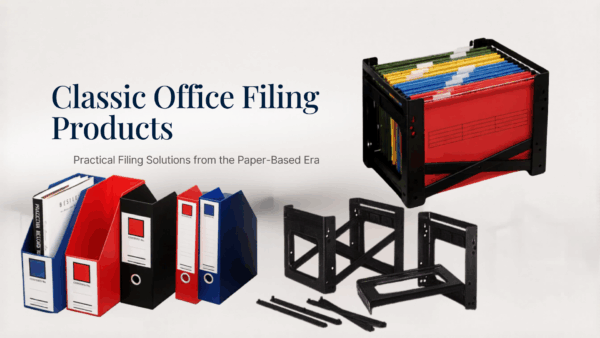
A Product Line Designed for the Paper-Based Office
Before digital forms, QR codes and online applications became common, paper was part of every business workflow. Offices printed internal documents. Schools prepared student forms. Stores kept price sheets and product information. Service counters handed out registration forms, warranty documents, application sheets and customer records every day.
In that environment, classic office filing products were not just stationery items. They were practical tools that helped people manage paper faster and more clearly.
Products such as magazine files, A4 open document holders, desktop trays, hanging file systems and filing racks were widely used because they solved a very simple but important problem: documents needed to be visible, sorted and easy to access.
For a company with more than 40 years of manufacturing experience, this product line represents an important stage of office product development. It shows how practical storage products were created to support real daily business operations.
Why These Products Were Once So Practical
The reason these filing products became common was not because they were complicated. Their value came from simplicity.
In a paper-based workplace, documents moved constantly. Staff needed to print, sort, hand out, collect, store and retrieve paper throughout the day. If all documents were placed in one pile, work quickly became slow and messy.
Classic filing products helped solve this by giving every type of document a clear place.
Easy to See
Open filing products made documents visible. Staff could quickly identify which form, catalogue or file was needed without opening drawers or searching through stacks of paper.
Easy to Take
Different colours, labels and file sections helped users separate forms by category, department, subject or purpose. This made daily work more organised.
Easy to Classify
Different colours, labels and file sections helped users separate forms by category, department, subject or purpose. This made daily work more organised.
Easy to Replenish
When forms were running low, staff could see it immediately. This was especially useful for counters, schools, clinics and offices that used the same documents repeatedly.
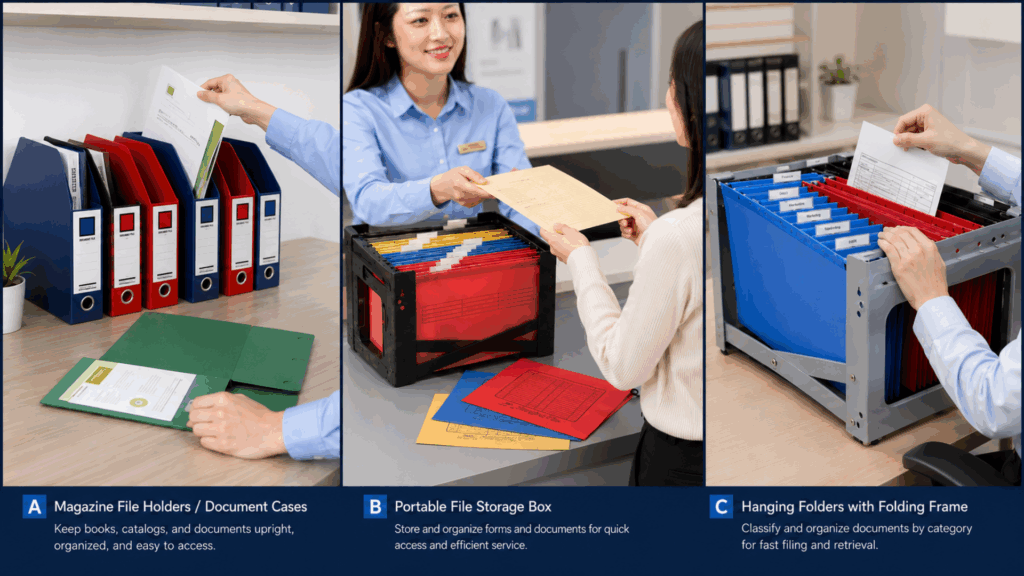
The Real Selling Point Was Workflow Efficiency
From a Top Sales perspective, these products were never only about storage. Their strongest value was workflow efficiency.
A basic filing product could help reduce repeated questions, shorten searching time and make a counter or office look more organised. This was especially important in places where staff needed to serve many people quickly.
For example, a store could place membership forms, warranty forms or product information sheets in open document holders. A clinic could separate registration forms, consent forms and patient information sheets. A school office could organise student forms, class notices and administrative documents.
The product helped people find the right paper at the right time.
Useful for Customer-Facing Counters
Open A4 filing products were friendly for businesses that needed customers to fill out forms. Customers could take the form directly, while staff saved time explaining or searching.
Useful for Internal Office Work
Inside offices, filing racks and desktop organisers helped departments separate active documents, pending files, catalogues and reference materials.
Useful for Schools and Institutions
Schools, training centres and public institutions often handled large amounts of paper. Filing products helped keep forms and teaching materials organised by class, subject or department.
The Products May Be Gone, but the Workflow Logic Remains
Although many of these classic filing products are no longer in production, their value is still worth remembering. They were created for a time when paper documents were part of everyday business operations, and their design reflected a very practical purpose: helping people see, take, classify and manage documents more efficiently.
Today, many forms have moved online. Customers fill out information through websites, QR codes or digital systems. Offices rely more on cloud storage, shared folders and electronic records. Because of this shift, the demand for some traditional paper filing products has naturally decreased.
However, the thinking behind these products has not disappeared.
Good office products were never only about holding paper. They were about reducing confusion, improving workflow and making daily tasks easier for both staff and customers. Whether the tool is a paper file holder, a form box, a hanging folder system or a digital document platform, the core purpose is still the same: helping people find the right information at the right time.
From a Top Sales perspective, this is the most important lesson these products leave behind. A product does not need to be complicated to be useful. Sometimes, the best-selling products are the ones that solve a small but repeated problem in daily work.
These filing products may belong to a more paper-based business era, but they still remind us of one simple truth:
A good product helps people work with less friction.