
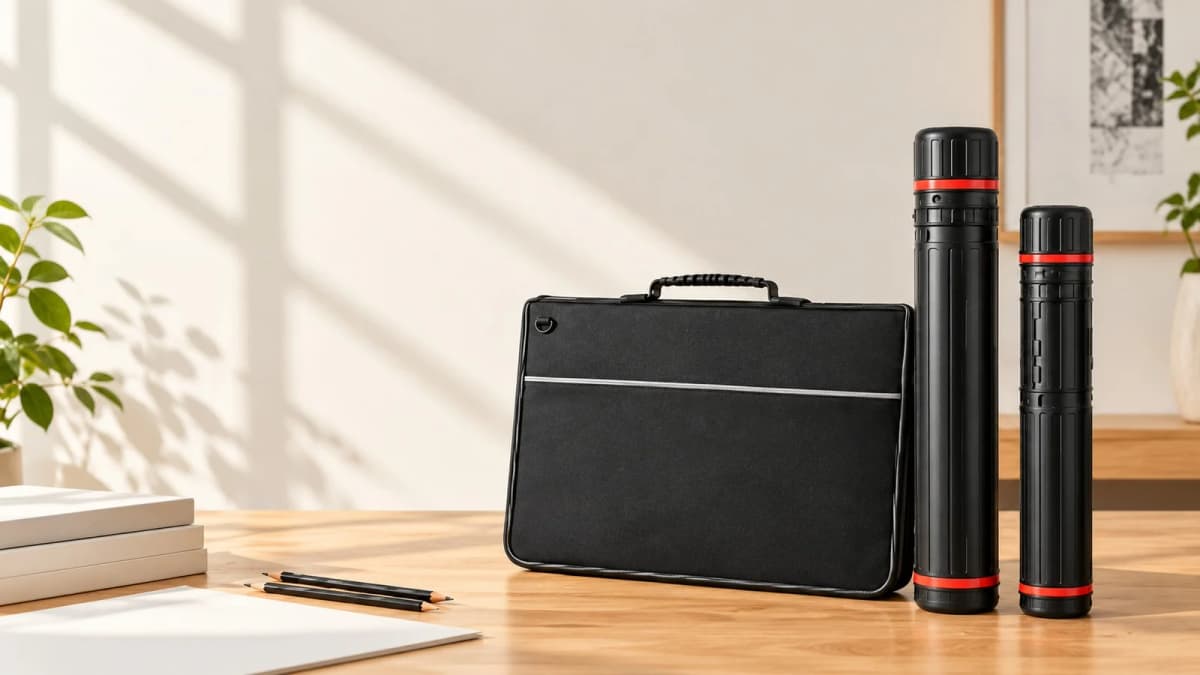
Buying portfolio cases wholesale is different from buying finished stock from a retailer. Importers, distributors, art supply companies, stationery brands and school suppliers need answers on minimums, lead times, customisation, sampling and shipping terms before the first order, not after.
This guide covers what to check, and how we handle each point.
Our terms at a glance
| Mokichi® stock | Mix any catalogue items in one shipment; minimum shipment value US$6,000 |
| OEM / private label | MOQ 500 pcs per style and size |
| Sampling | 10–15 days after specs are confirmed; sample fee credited to the bulk order |
| Production | 45–60 days after deposit and sample approval |
| Payment | 30% deposit; 70% balance when goods are ready to ship |
| Shipping | FOB Shanghai; EXW on request |
What does MOQ actually mean for portfolio cases?
It depends on the supplier, so always ask how it's counted. Some factories set a minimum for every item, size or colour; others set it on the total order value. The difference matters when you plan to carry several sizes.
We use two minimums, depending on what you order:
- Mokichi® stock (our own registered brand): combine different products and sizes in one shipment, from a minimum shipment value of US$6,000. For example, A1 and A2 drafting bags, A3 ring binders, A4 presentation books and carrying tubes together. It's a practical way to test several sizes without overstocking one SKU.
- OEM / private label (your brand or specification): 500 pcs per style and size.
Questions worth asking any supplier:
- Is MOQ counted per SKU, per order, or per shipment value?
- Can sizes and colours be mixed?
- Is there a separate minimum for custom colours, printed logos or special materials?
How do lead times work for first orders and reorders?
Treat sampling, production and shipping as three separate stages, and confirm each one in the quotation.
- Sample lead time: preparing or adjusting a sample. Ours is usually 10–15 days after specifications are confirmed.
- Production lead time: making the bulk order. Ours is usually 45–60 days after the deposit and sample approval. Quantity, materials and the level of customisation all affect it, and busy seasons can add time.
- Shipping time: transport after production, which depends on your route and forwarder.
A first order takes the longest, because materials, dimensions, logo placement, colours and packaging all need confirming. Reorders usually move faster once those details are approved and on file.
What can be customised on an OEM or private-label order?
Anything from a logo on an existing product to a new design. Depending on the construction, that includes:
- Logo printing, embossing or debossing, woven labels and hang tags
- Colours and materials (PP, Oxford fabric, PU, canvas)
- Dimensions, including B sizes and US sizes
- Handles, shoulder straps, zips and closures
- Pockets, inside compartments and ring binding
- Retail packaging, barcode labels and carton markings
The quickest route is usually to adapt an existing product rather than develop a new one. For example, keep the structure of an A3 portfolio case and change the colour, handle, logo, packaging or pocket layout. That shortens development while still giving you your own product.
To get an accurate quote, send target dimensions, reference photos, material requirements, logo files, Pantone colours if needed, packaging needs, expected quantity and target market. More on what can change: OEM & Custom.
Why sample before the first bulk order?
Because a spec that looks right on paper can feel different in the hand. A sample lets you check material thickness, surface texture, stiffness, stitching, zip quality, handle comfort, strap length, pocket position, logo placement and finished size.
It also gives both sides the same physical reference, which avoids misunderstandings in production. Changes are easy at the sample stage and expensive after bulk production starts.
Test it the way it will be used: put artwork inside, carry it loaded, check the handle position and open and close it repeatedly. Our sample fee is credited to the bulk order once it's confirmed.
What should you ask about where and how products are made?
Enough to know the supplier can make the same product again next year. Useful questions:
- How long has the manufacturer made this product category?
- Which processes are done in-house, and which are subcontracted?
- Can existing designs be modified?
- Does the supplier have export experience?
- What quality checks happen before shipment?
- Can specifications be kept consistent for reorders?
Our own background: we started with PP file folders in 1976 and are now run by the second generation, with production in our own factory in China and sales coordination from our Taiwan office. Over the years that has covered portfolio cases, presentation books and document storage in PP, fabric and PU.
That history matters because small structural details decide how a portfolio case holds up: handle placement, material thickness, welding, stitching, reinforcement and zips. They matter most on A1 and A2 cases, which must carry large work without becoming awkward to hold.
What does FOB mean for your order?
Under FOB, the seller handles export and loads the goods onto the vessel at the named port; from there, the buyer or the buyer's forwarder manages and pays for international freight.
Our quotations are usually FOB Shanghai, with EXW available on request, and we can consolidate shipments to your forwarder's instructions. If you already work with a forwarder, FOB lets you use your own logistics partners.
When comparing suppliers, make sure prices use the same shipping term. A lower EXW price can't be compared directly with an FOB price, because different costs are included. Before confirming, also check:
- Port of loading
- Carton dimensions, gross and net weight, and total CBM (carton quantity and CBM are listed on each of our product pages)
- Packing method and documents required
- Your forwarder's contact details
Frequently Asked Questions
What is your minimum order?
For Mokichi® stock, a minimum shipment value of US$6,000, with different products and sizes mixed in one shipment. For OEM or private-label orders, 500 pcs per style and size.
Can I mix different portfolio sizes in one order?
Yes, for Mokichi® stock: A1, A2, A3 and A4 products and other catalogue items can be combined towards the US$6,000 shipment minimum. OEM orders are counted per style and size.
Do you offer private-label manufacturing?
Yes. Logos, colours, dimensions, materials, handles, straps, pockets, zips and packaging can be customised, depending on the product's construction.
Can you make a portfolio case based on my design?
In many cases, yes. Send reference photos, drawings, specifications or a sample, and we'll check whether it can be made or adapted with our production setup.
How long does production take?
Usually 45–60 days after the deposit and sample approval. Sampling takes 10–15 days. Custom materials or busy periods can add time, so we confirm the lead time in each quotation.
What are your payment terms?
A 30% deposit confirms the order; the 70% balance is paid when the goods are ready to ship.
What shipping term do you use?
FOB Shanghai, unless another arrangement is agreed. EXW is available on request.
Key takeaways
- Ask how MOQ is counted. Ours: US$6,000 per shipment for mixed Mokichi® stock, 500 pcs per style and size for OEM.
- Treat sampling (10–15 days), production (45–60 days) and shipping as separate stages.
- Adapting an existing product is the fastest route to your own branded range.
- Always approve a sample before bulk production.
- Compare quotes on the same shipping term.
Choosing what to stock? Read Zipper vs. Ring Binder Portfolio and our portfolio range guide. Ready to quote? Send us your target size, reference photos, quantity and customisation needs.