
After file folders and clip files were in wide use, customers started asking for something more flexible. A folder collects documents and a clip file holds them in place, but neither lets you protect each sheet, turn pages like a book, or build a presentation you can update. Refill pages filled that gap, and they became one of the longest-running lines in our family factory. (Previous chapter: from file folders to clip files.)
Why did inner pockets become necessary?
Because loose paper doesn't survive handling. As offices, schools, training centres and sales teams used more printed material, pages got bent, stained, creased or lost. A folder kept them together but didn't let anyone look at one page at a time.
With refill pages, each sheet goes into its own clear pocket. Users flip through them, protect the pages that matter, and swap pages in or out. That suits office reports, school handouts, training materials, price lists, catalogues, certificates, artwork samples and presentation documents. A simple product with a very wide range of uses.
Why did sizes matter so much?
Because not everyone uses the same paper. Offices and schools mostly need A4. Artists, designers and architecture students need larger sizes for drawings, posters and presentation boards. Offering several sizes let one product serve several markets: more shelf options for retailers, more coverage for schools, and proper protection for large flat artwork.
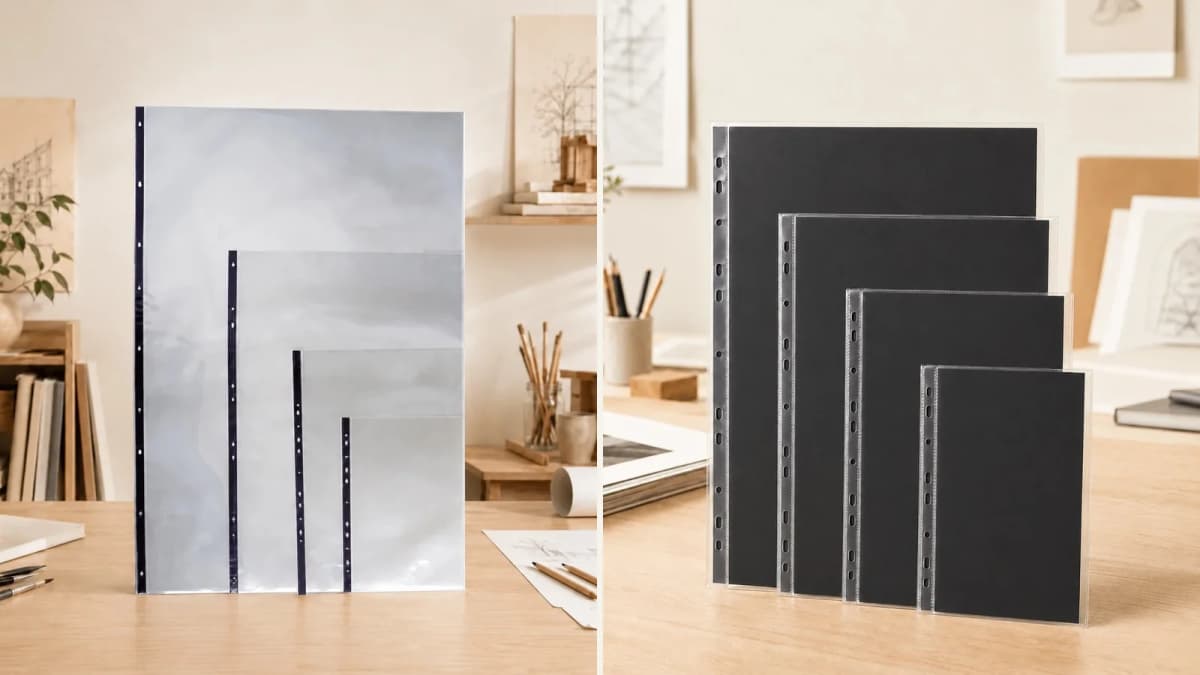
That's still how our current refill sleeves are built. Both lines come in four sizes, A4 to A1, matched to our portfolio cases:
| Paper size | Sleeve size (mm) | Clear sleeve | With black paper |
|---|---|---|---|
| A4 | 305 × 235 | 305A | 51400 |
| A3 | 430 × 320 | 305D | 51300 |
| A2 | 600 × 450 | 305E | 51200 |
| A1 | 860 × 620 | 305F | 51100 |
Full packing details are on the Sheet Protector Plastic Sleeves and Sleeves with 80g Black Paper pages. The black backing sheet gives artwork and photos more contrast.
How did a coloured edge strip change sales?
Early inner pockets mostly had plain black strips. Later we added colours, and that small change mattered. Users could sort documents by colour (one for each subject, department, project or customer) without labels.
The core product didn't change at all. But a colour range turned a single item into a series. Retailers got more to display, customers got a reason to choose, and wholesalers got a broader line to offer. Product development doesn't always need a new invention. Sometimes it's a detail users actually notice.
Why are refill pages still selling decades later?
Because the need behind them hasn't changed. People still protect important papers, keep pages in order, present work clearly and update content. Schools, offices, exhibitions, sales meetings and portfolio reviews all still use physical pages.
Refill pages aren't a trend product; they're a support product, and support products bring repeat orders. A customer buys one ring binder portfolio and keeps buying sleeves as the portfolio grows. For a retailer, sleeves sold next to the binder keep the whole category moving.
What did making them teach us?
Precision. Refill pages pushed us further into page protection, accurate sizing, edge sealing and hole punching that lines up with the rings every time. That know-how went straight into display books, presentation books, ring binder portfolios and the sleeves that go inside them today.
Frequently Asked Questions
What's the difference between a refill page and a fixed-sleeve presentation book?
Refill pages are loose and fit into a ring binder, so they can be added, removed or reordered. In a fixed-sleeve presentation book, the pockets are bound in permanently.
What sizes are your refill sleeves?
A4, A3, A2 and A1, in clear and black-paper versions. Sleeve sizes run from 305 × 235 mm (A4) to 860 × 620 mm (A1).
Why use sleeves with black paper?
The black backing gives artwork and photos more contrast and adds stiffness, which helps in portfolio reviews and displays.
Do the sleeves fit your ring binder portfolios?
Yes. They're sized to match our A4 to A1 ring binder portfolios and can also be used in drafting bags and presentation folders.
Can refill sleeves be customised?
Yes, on OEM orders: size, material and packaging can be adjusted. OEM MOQ is 500 pcs per style and size, and Mokichi® stock items can be mixed from US$6,000 per shipment.
Looking back, moving forward
From file folders to clip files, and from clip files to refill pages, each step came from what customers actually needed. Next chapter: from document protection to pencil cases. Or start at the beginning: our manufacturing roots since 1976.
Stocking binders or portfolios? Add matching sleeves from the catalogue, see OEM & Custom, or send us your requirements.