
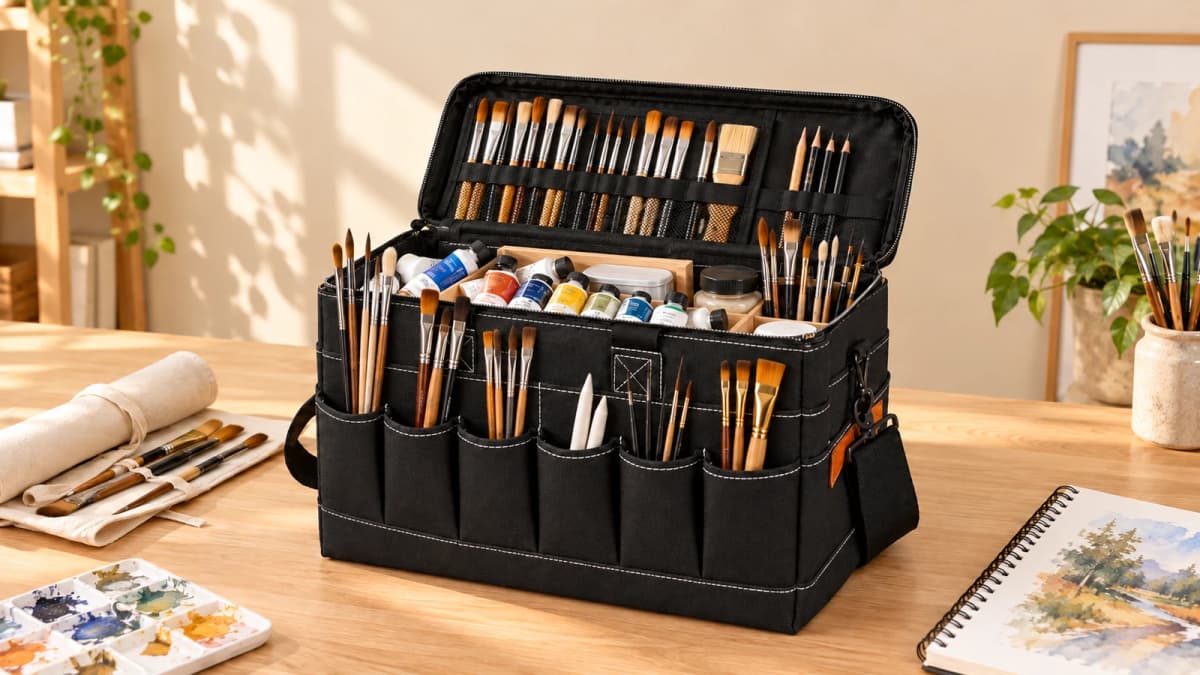
A paint bottle, a long brush, and a sketchbook ask different things of a bag. Put them together and the differences become obvious: the bottle needs to stay secure, the brush needs clearance, and the sketchbook needs room without being bent around everything else.
Before comparing bags, lay out your usual kit. Include the awkward things: the pencil case you never unpack, the longest brush, the water container, and anything you carry home after class. That small inventory will tell you more than a product photo.
What should an art supply bag hold?
Start with your largest items and check usable space. A bag needs enough room for your kit to fit together while still closing properly.
Measure the largest flat item, the tallest container, and any rigid box. Published bag dimensions are a starting point; they may not describe the internal space or the opening. Ask for usable internal measurements if the fit is close. Rounded corners, dividers, and the zipper can all affect what goes inside.
Try planning the load in three groups:
Flat items: sketchbooks, loose paper, reference sheets, and palettes.
Bulky items: paint boxes, marker cases, bottles, and containers.
Small tools: pencils, brushes, erasers, clips, and sharpeners.
Leave enough room to take something out without unloading everything. Extra space is useful, but a much larger bag can also let loose items shift around.
Keep finished artwork in mind, too. If you regularly carry large sheets or presentation boards, a separate portfolio may be a better fit alongside your supply bag. For a broader view of those options, see our art storage guide by workflow.
Which opening makes your supplies easier to reach?
Match the opening to how you pack and work. A secure closure helps during transport; an opening that stays clear makes tools easier to reach at the table.
A zip-top bag is worth considering when you move between rooms or carry supplies on public transport. Check whether the zipper closes with your tallest items packed, and whether you can see into the main compartment without pushing the sides apart.
The Canvas Art Supply Tote combines a zip-top closure with a spacious main compartment and multiple exterior pockets. It is an option to compare when you want larger materials inside and frequently used tools close to hand.
For work at a table, consider what happens to the lid once the bag is open. Does it fall back over your supplies? Does it take up space beside you? The Structured Studio Tool Tote has a roll-away top lid that keeps the main compartment open during use.
Those exterior pockets deserve a separate check. An easy-access pocket may leave a tall tool exposed. Make sure its depth suits the item and that the item stays secure when you lift the bag.
How many compartments do you actually need?
Choose compartments that fit your tools, not a pocket count. A few useful spaces can make packing easier than many pockets that are too narrow or shallow.
Fixed pockets work well when you carry a similar kit each time. If one class needs marker boxes and another needs paints, adjustable organization gives you more flexibility. The Structured Studio Tool Tote includes two movable divider panels, letting you arrange the main compartment around different supplies.
Small removable cases can help when you already have a bag you like. Keep pencils together, collect loose accessories in a pouch, and give brushes their own space. Our Artist Brush Roll uses individual brush slots and a roll-up design for portable storage.
Organization also involves what happens after painting. Winsor & Newton advises letting watercolour brushes dry fully before storing them in its brush-care guide. Allow time for that step rather than packing damp brushes tightly into a closed kit.
For bottles and paint containers, check lids before packing and keep them apart from loose paper. A divider helps separate items; it does not make a compartment leakproof.
Which carrying style fits your routine?
Choose a carrying style around your usual journey. Think about walking distance, stairs, and what your hands and shoulders are already carrying.
Hand-carry handles may suit short trips from a car to a studio. The Canvas Art Supply Tote has dual handles with wrapped grips. If you usually carry a backpack as well, consider how a separate tote will feel when both are loaded.
For shoulder bags or backpacks, check the actual model for strap adjustment, padding, and attachment details. These features vary; do not assume a tote includes a shoulder strap unless the specification says so.
If you can inspect a sample, pack your normal supplies and try these checks:
Lift the bag and see whether the contents shift.
Walk with the other bag or portfolio you normally carry.
Put it down, reopen it, and take out the tool you use most often.
Check that long handles, loose straps, or exposed tools do not get in your way.
A bag that feels convenient empty can behave differently once it holds bottles and tool boxes. For school or wholesale orders, this is a useful sample check before choosing a model for a group.
What should you check about cleaning?
Read the care instructions before choosing a material. Fabric type alone does not tell you whether a complete bag can be washed.
Check the lining, base, seams, and interior corners. Ask how to clean the bag and whether any inserts can be removed. Paint residue and pencil shavings are easier to deal with when you can reach the bottom without working around permanent obstructions.
Manufacturer instructions matter. For example, Eastpak's product-care guide gives cleaning restrictions for its own bags. Those instructions should not be transferred to a different product simply because both are fabric bags. Follow the guidance supplied for the model you buy.
The Structured Studio Tool Tote has a PVC base described as helping protect against damp, dirt, and everyday wear. That feature does not establish that the entire tote is waterproof or machine washable. Confirm the appropriate cleaning method if that is an important part of your buying decision.
Which setup works for classes, studios, and travel?
Choose around the part of your routine that causes trouble. For some people that is carrying the kit; for others it is finding tools once they sit down.
Setting | What to prioritize | Options to compare |
|---|---|---|
Classes | A closure that works with the full kit, accessible pockets, and a manageable load | Canvas Art Supply Tote; a brush roll for separate brush storage |
Studio | An upright structure, adaptable compartments, and a lid that stays out of the way | Structured Studio Tool Tote |
Workshops and local travel | Secure packing, quick setup, and organization that works alongside your other luggage | A suitably sized tote with removable tool cases or a brush roll |
Treat these as starting points. A compact drawing kit and a painting kit with bottles may need different arrangements even when both go to the same class. For travel involving a flight, check current carrier rules separately for the supplies you intend to pack.
What should schools and art stores stock?
Most programs need two bag types, not ten: a structured tool tote for studio work and a lighter zip-top tote for carrying between classes. Brush rolls work well as an add-on.
A short range is easier to explain to students and parents, and easier to reorder. When you plan it:
- Start from the course supply lists. A drawing class and an acrylic painting class pack very differently.
- Check the largest required item (the sketchbook size, the paint set box) against the bag's internal dimensions, not the outside measurements.
- Order samples and pack them with a real class kit before committing to a quantity. The carrying checks above work just as well for a buyer as for a student.
- Decide early whether you need a custom version. Divider layout, pocket depth, colours and a school or store logo can all be specified on an OEM order.
For custom configurations and private label, see OEM & Custom.
Frequently asked questions
Can I use a regular tote bag for art supplies?
Yes, if it fits your kit and keeps items organized. Add separate cases where needed, and check the closure, base, and pocket depth. If supplies pile up or shift whenever you move, a bag with dividers or more suitable pockets may be easier to use.
How big should an art supply bag be?
It should fit your largest items together and still close without forcing them. Compare internal space and opening measurements with your packed kit. Avoid relying on a size label or exterior dimensions alone.
Is an art supply bag the same as a portfolio bag?
They serve different packing needs. An art supply bag usually accommodates tools and containers, while a portfolio bag is arranged around flat artwork. You may need both when carrying supplies and large sheets together.
Are more pockets always better?
No. Pocket dimensions and placement matter more than the total. Check whether your actual tools fit securely and whether you can reach them while the main compartment is packed.
Can I machine wash an art supply bag?
Only when the manufacturer confirms it. Linings, coatings, inserts, and structural parts can require different care. Ask for the cleaning instructions for the exact model before washing it.
How can I carry a small art kit inside a backpack?
Group tools in a compact case or roll, then check the remaining space for your sketchbook and other items. Make sure the organizer fits through the backpack opening and that its contents are not pressed against fragile items.
What should you check before ordering?
Pack your usual kit, close the bag, and try carrying it. Check the opening and pockets again while it is full. This is also the moment to confirm internal dimensions, cleaning instructions, and any strap features you need.
For schools, art stores, or custom orders, send the items you need to carry, intended use, preferred configuration, and estimated quantity through our contact page. Those details give us a practical starting point for discussing a suitable bag.