
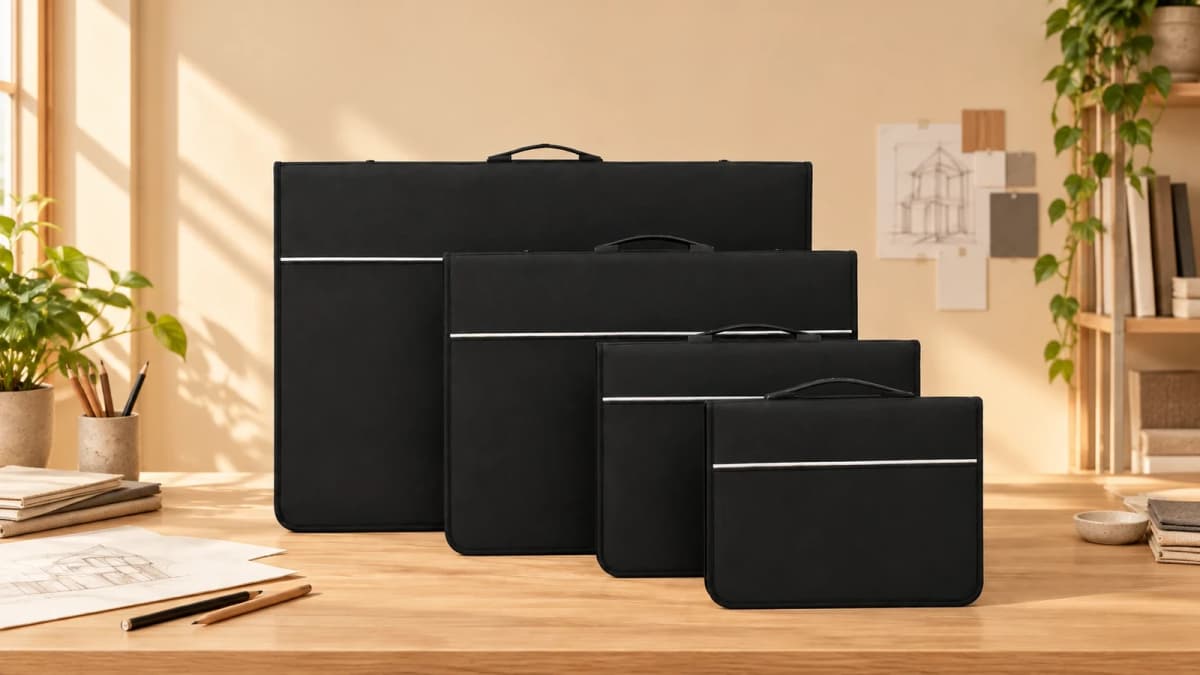
Most portfolio damage doesn't happen on the way to a review or a client meeting. It happens in the weeks the case sits behind a door, under a stack of books, or on a damp floor.
The fixes are simple and cheap. Below are the ten habits that matter most, what to look for in a case if protection is the priority, and how schools and retailers can store portfolios in bulk.
Why does between-use storage matter?
Paper reacts to its surroundings even when nobody is touching it. Humidity makes sheets curl and cockle, light fades ink and color, and steady pressure leaves marks that don't come out.
Temperature matters more than people expect. Research cited by the Northeast Document Conservation Center found that lowering storage temperature by 5°C roughly doubles the life of paper. The case itself is also at risk: a portfolio that's left bent or overloaded can lose its shape for good, and a warped case no longer holds artwork flat.
How should you store an art portfolio? 10 habits
1. Keep it flat or upright, never bent
Store a portfolio either flat on a clean shelf or standing upright like a large book, supported on both sides. What you want to avoid is a lean, a curve, or anything heavy on top.
Boxes, books or equipment stacked on a case will deform it over time and can press marks into the work inside. For A1 and A2 sizes, check that the shelf or cupboard is wide enough that the corners aren't pushed against a wall.
2. Keep humidity steady, around 45–55%
Paper is safest at a relative humidity of about 45–55% and 15–25°C, with no more than about 5% change in a day. That's the range given in the Western Australian Museum's conservation manual, and the Texas State Library recommends the same band.
You don't need a museum to get close. Keep portfolios off the floor, away from exterior walls, and out of basements, garages and storerooms. Too much damp leads to:
- curling and cockled paper
- mold and mildew
- yellowing and stains
- tape and adhesive letting go
- sleeves sticking to the artwork
In a humid climate, a small moisture absorber near the storage spot helps. Swap it out before it's full.
3. Keep it out of direct sunlight
UV light fades artwork even through a clear sleeve. Ink, markers, colored pencil, watercolor and inkjet prints are the first to go.
Choose a cupboard, drawer or shelf away from windows. A transparent cover is good for presentation, but it isn't UV protection.
4. Put delicate work in sleeves, but choose the right kind
Loose sheets rub against each other every time the case is moved. Sleeves stop that friction for drawings, prints, photographs and design boards.
Be careful with powdery media. The Library of Congress notes that polyester film builds up static that can lift pastel, charcoal and soft pencil off the paper. For those, use a paper interleaf instead (see the next habit), and never sleeve work that is still wet or tacky.
5. Separate fragile surfaces with interleaving
Charcoal, pastel and soft graphite transfer onto whatever touches them. A clean sheet between each piece stops one drawing from smudging the next.
Glassine is the usual choice because it's smooth and doesn't hold loose particles. It does break down over time, so conservators treat it as short-term. For work you'll keep for years, acid-free tissue or buffered paper is the safer interleaf.
6. Don't overfill the case
If the portfolio bulges when it's closed, it's too full. Overfilling bends corners, strains zippers and binder rings, distorts the case, and makes it hard to pull work out without damage.
A simple fix: one portfolio for current work, a second for finished or archived pieces.
7. Clean and dry the case before putting it away
Shake out eraser crumbs, paper scraps and dust before the case goes into storage for weeks or months. A soft dry cloth is enough for PP and plastic surfaces. Fabric cases may need gentler care, depending on the coating.
Let everything dry completely before the artwork goes back in. A slightly damp case that's closed for a month is a good way to grow mildew.
8. Check zippers, handles and straps
A portfolio is a carrying product as well as a storage one, so the hardware wears too. Before storing it, check that:
- zippers run smoothly
- handles are still firmly attached
- shoulder straps aren't twisted
- buckles and clips aren't under tension
For long storage, loosen adjustable straps. That takes the strain off the webbing, stitching and hardware.
9. Label every stored portfolio
Once there's more than one case, an outside label saves real time. Write down the project, year, artwork size, and the client, course or archive category.
This matters most for studios, schools, architecture offices and design departments, where several people need to find the right work quickly.
10. Check stored work every few months
Every two to three months, open the case and look for:
- damp or a musty smell in the storage area
- paper starting to curl
- sleeves sticking together
- pressure marks from things stacked nearby
- dust or insects
Problems caught early are usually easy to fix.
Which portfolio type protects artwork best?
A rigid or semi-rigid case gives the most protection in storage, while a soft case is lighter and easier to carry every day. Many artists end up owning one of each.
| Rigid / semi-rigid case | Soft case | |
|---|---|---|
| Typical materials | PP board, covered board, PU | Oxford fabric, canvas |
| Protection against bending | High | Low to medium; needs flat storage |
| Weight | Heavier | Lighter |
| Best for | Presentation boards, finished work, storage | Daily carrying to class or the studio |
Whichever type you choose, these five points decide how well it protects the work:
- Size: the artwork should fit without bending or forcing the corners.
- Structure: rigid or semi-rigid sides keep sheets flat.
- Closure: a zipper, buckle or secure flap stops work from sliding out.
- Inside: sleeves, pockets, dividers or ring binders keep different types of work apart.
- Carrying: handles and a shoulder strap matter if the portfolio travels often.
For a closer look at closure types, see Zipper vs. Ring Binder Portfolio: Which Should You Stock?
How should schools and retailers store portfolios in bulk?
Store portfolios upright in labeled, open-fronted racks or shelves, with each slot sized to the case, and never piled flat in tall stacks. The same rules apply as at home, just at a larger scale.
In the classroom
- Give each student a slot rather than one shared pile, so cases aren't pulled out from underneath others.
- Keep racks off exterior walls and away from sinks and windows.
- Label the spine side with the student's name and class, so cases can be found without being opened.
- At the end of term, have students empty and wipe their cases before summer storage.
In the shop or warehouse
- Keep stock in its export cartons until it goes on display, and keep cartons on pallets, not on the warehouse floor.
- Don't stack cartons so high that the bottom layer gets crushed.
- On the shop floor, display large sizes upright in a bin or rack so the corners aren't bent by customers flicking through them.
If you're planning a range for a school program or a store, our wholesale buyer's guide covers MOQ, lead times and private label.
Frequently Asked Questions
How often should I check on artwork in storage?
Every two to three months is enough for most people. Look for damp, curling paper, sleeves sticking together, pressure marks and dust or insects.
What humidity level is safe for storing artwork?
About 45–55% relative humidity at 15–25°C, kept stable. Conservation guidance stresses that steady conditions matter as much as the exact number, so avoid places where humidity swings from day to day.
Is it safe to store a portfolio in a basement or garage?
It's best avoided. Basements and garages tend to be damp and change temperature quickly, which leads to curling, mold and failing adhesives. A dry indoor room away from exterior walls is safer. If you have no other option, raise the case off the floor and monitor the humidity.
Plastic sleeves or glassine paper: which is better for separating artwork?
For finished work that doesn't smudge, such as prints, photographs or inked drawings, clear sleeves are fine. For charcoal, pastel and soft pencil, use a paper interleaf such as glassine or acid-free tissue, because plastic sleeves can build up static and lift the powdery surface.
Can I stack portfolio cases on top of each other?
Only lightly, and only rigid cases. Stacking puts steady pressure on the bottom case and the work inside it. Standing cases upright in a rack or on a shelf is better, especially for soft cases.
Rigid or soft-sided portfolio case: which protects better?
A rigid or semi-rigid case protects better against bending and pressure, which makes it the better choice for storage and presentation boards. A soft case is lighter and easier for daily carrying, but it needs to be stored flat or well supported.
Key takeaways
Dry, supported, clean, not overloaded. Those four conditions prevent nearly all between-use damage to artwork and portfolio cases.
- Keep relative humidity around 45–55% and the case off the floor.
- Store flat or upright, with nothing heavy on top.
- Use paper interleaving, not plastic sleeves, for charcoal and pastel.
- Split work across two cases before one starts to bulge.
- Check stored work every few months.
For schools, art supply distributors, studios and brands: we manufacture portfolio cases in custom sizes, materials, inner layouts, handles, straps and branding. See OEM & Custom or send us your requirements.