
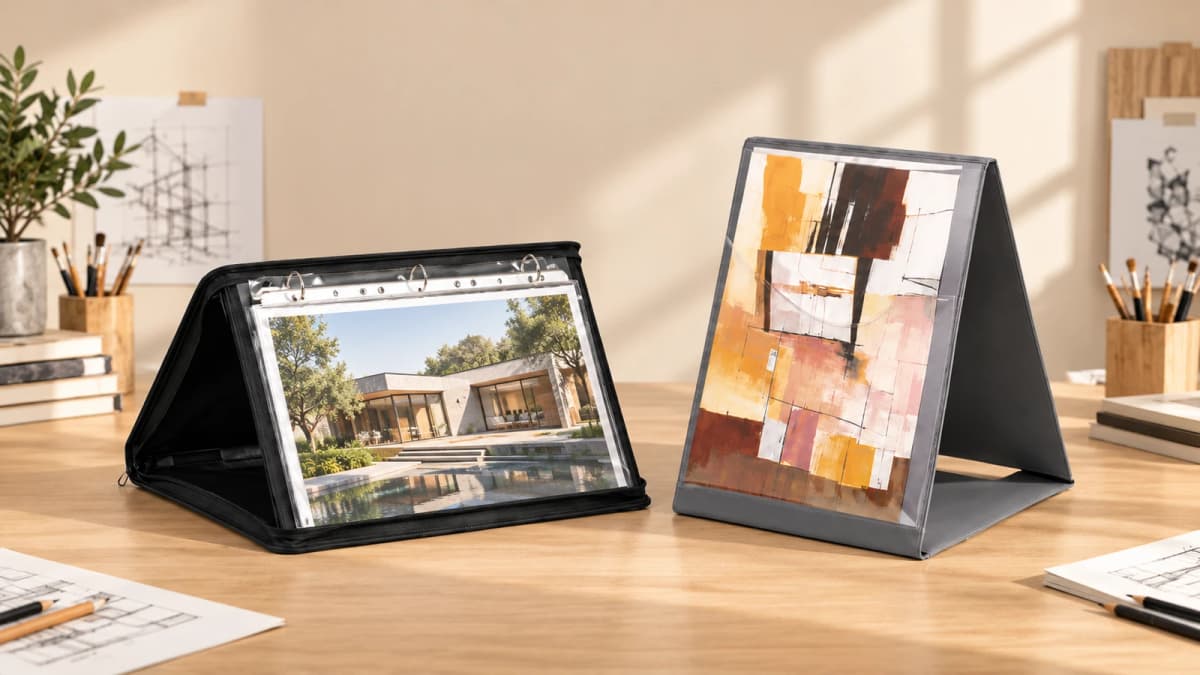
Order the wrong orientation once and you see why this question matters. A display book in the right size but the wrong shape still gets returned, still sits on the shelf, and still frustrates the student who planned a whole portfolio around it.
Most guides on this topic are written for one person picking one book. This one covers that, and also the question buyers actually face: if you're a retailer, distributor or school buying in volume, which orientation should you stock?
What is a display portfolio, and what do "horizontal" and "vertical" mean?
A display portfolio is a bound book of clear sleeves for showing documents or artwork. Horizontal sleeves are wider than tall, vertical sleeves are taller than wide.
The same product is sold under three names depending on who sells it: a stationery store calls it a display book, a photography supplier calls it a presentation book, and an art store often calls it a portfolio case. It's the same category. That matters when you search for suppliers, because searching one name alone misses a lot of the market.
Orientation is set by the sleeve, not by what you put in it. A portrait photo in a landscape sleeve leaves blank space on both sides. Both orientations are made across the usual size range, from A4 (or 8.5×11 in) up to A3 and larger.
How do horizontal and vertical compare at a glance?
Horizontal suits wide, visual content. Vertical suits tall or text-heavy content.
| Orientation | Typical sizes | Best for |
|---|---|---|
| Horizontal (landscape) | A4, A3, 11×8.5 in, custom wide formats | Wide photography, panoramas, product catalogs, real estate spreads, counter display |
| Vertical (portrait) | A4, A3, 8.5×11 in, custom tall formats | Text documents, certificates, single-figure portraits, menus, school and office filing |
See both formats in our range: Horizontal Display Portfolio and Vertical Display Portfolio.
Why does orientation change how people look at a portfolio?
People tend to scan a scene side to side more than up and down. Eye-tracking studies have measured this "horizontal bias" repeatedly; one study of 47 adults and 41 infants viewing real-world scenes (2016) found it in both groups, and later research in PubMed Central shows eye movements tend to follow the horizon of an image.
That helps explain why a wide spread feels natural to browse, while a tall page reads more like one focused document. It shows up online too: Baymard Institute's mobile usability testing (2018) observed shoppers turning their phones sideways to see product images larger.
Which orientation fits which use case?
Choose by what goes inside the sleeves, not by personal preference.
Retail display and catalogs
A wide spread shows more product per page, which is why counter display and catalog use often leans horizontal.
Art and photography portfolios
Landscape favors wide subjects: scenery, cityscapes, weddings, group shots, travel. Portrait favors tall or single-subject work: fashion, portraiture, single buildings, much illustration. Mixing both in one book is normal. The choice is about which type you have more of and want to lead with.
Menus and hospitality
Both are common. Menu holders are often built with swivel frames so staff can switch between landscape and portrait when the menu layout changes.
Real estate and sales presentations
Landscape usually works better for property listings and sales decks built around wide photos. A room panorama or floor plan reads more easily across a wide page.
Certificates and text-heavy documents
Portrait is the default, because certificates, forms and standard printed pages are already laid out that way. Turning a text document sideways mostly adds white space.
Should retailers and distributors stock both orientations?
It depends on who your customers are. Every channel has its own mix, so look at your own sales and customer requests before deciding, rather than following a general rule.
As a starting point:
- School-supply channels often lean portrait, for filing, reports and certificates.
- Design stores and real-estate or photography suppliers often lean landscape.
- General stationery and art retailers usually serve both kinds of customer, so carrying both formats avoids losing a sale when one runs out.
Two practical checks before you place an order:
- Quote each format separately. Price and lead time depend on size, sleeve count, cover material and quantity, so confirm them for each version you plan to stock.
- Check your display fixtures. Measure shelves, slots and counter racks against the outer size of each format, so stock fits your shelf plan when it arrives.
If you're planning a range, our wholesale buyer's guide covers MOQ, sampling and private label.
How do art and design schools expect portfolios to be formatted?
There's no single standard. Each school sets its own rules, and they change from one admissions cycle to the next.
- College for Creative Studies asks Concept Design applicants for one multi-page PDF with every page in landscape orientation.
- School of Visual Arts asks graduate design applicants for images at 1920 × 1080 pixels, a 16:9 landscape frame.
- Rhode Island School of Design takes first-year portfolios as individual slides through SlideRoom, so orientation isn't fixed in the same way.
The takeaway for students, and for anyone selling to them: check the target school's current requirements before buying or building anything. Many schools now want a digital PDF portfolio, but a printed copy for interviews still benefits from the right physical book.
Frequently Asked Questions
What's the difference between a display book, a presentation book and a portfolio case?
Functionally, nothing: they're the same type of product under different names. "Display book" and "presentation book" are used almost interchangeably, while "portfolio case" sometimes means a version with a handle or closure.
Can I mix vertical and horizontal photos in one display book?
Yes. A photo that doesn't match the sleeve's orientation leaves blank space on two sides, but that's fine for a mixed portfolio.
Is landscape or portrait better for a photography portfolio?
It depends on your subject. Landscape suits wide subjects like scenery and group shots; portrait suits tall or single-subject work like fashion and portraiture.
Do I need to stock both orientations as a retailer?
It depends on your customers. Look at your own sales and requests first. Channels with one dominant use, such as school filing, can lean on one format; general stationery and art stores usually serve both.
What size portfolio should an art or design student buy?
Whatever the target school asks for. Requirements vary: some schools specify orientation and format, others accept individual images with no fixed orientation.
Does orientation change the price or lead time?
Ask your supplier to quote each version. Price and lead time depend on size, number of sleeves, cover material and quantity, so confirm them for every format you plan to order.
How do you choose, or stock, the right format?
Match the orientation to what goes inside. Wide and visual leans landscape, text-heavy and formal leans portrait, and a school's or client's stated requirements override both.
If you're stocking at volume, start from your own customers' needs rather than a general rule, and quote both formats before you commit.
We manufacture horizontal and vertical display books, presentation books and portfolio cases for stationery retailers, schools and brands, with custom sizes, colors, printing and private label. See OEM & Custom or send us your requirements.