
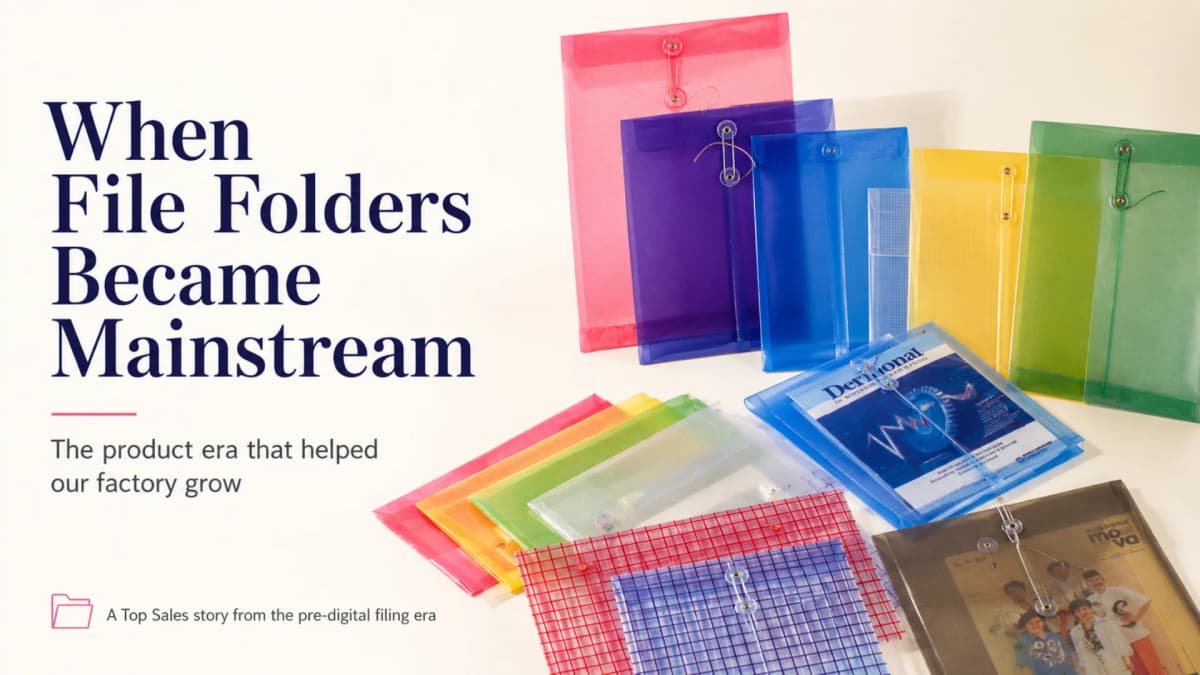
The file folder era: before cloud storage and tablets, a simple, affordable folder solved a problem everyone had — and that demand became one of the defining periods of our factory's growth.
There was a time when a file folder wasn't just one small item in a stationery catalogue — it was one of the products actually holding daily office work, school communication, and document organization together. Before tablets, cloud storage, and digital files took over, paper was everywhere: printed reports, invoices, quotation sheets, and contracts in offices; handouts, worksheets, and notices in schools and tutoring centers; forms and certificates families needed to keep properly.
File folders became mainstream in that era because they solved a plain, real problem: people needed a clean, affordable way to organize paper. For our factory, this was one of the defining stages of our history.
A Simple Product That Matched a Huge Market Need
Looking back, these folders were genuinely simple — lightweight, colorful, transparent or semi-transparent, easy to use. Some had snap buttons, some had string closures, some carried printed patterns, some were built to hold books or loose documents. From a sales standpoint, that simplicity was the whole point.
Nobody needed a folder explained to them. It was useful the second they saw it — holding school papers, office documents, forms, reports, manuals, course materials, personal records. That made it sellable everywhere: stationery stores stocked it, schools used it, tutoring centers customized it, offices bought it in bulk, wholesalers moved it in volume. The demand wasn't narrow. It came from everyday work and everyday learning, which is about as broad a market as a product can get.
Why These File Folders Sold So Well
Because they fit exactly how people worked at the time. No iPads in classrooms, no cloud folder for every student — paper was still the main carrier of information, and a folder to organize it wasn't optional.
A transparent folder let people see the contents at a glance. A colored one classified subjects or departments without a label. A snap-button folder kept documents from sliding out. A string closure gave thicker materials real security. Printed folders added visual appeal and brand identity. None of that was decoration for its own sake — each feature solved a specific, real problem, which is exactly why the market responded the way it did.
The Time When Orders Kept Coming
This product category became one of our real turning points. Demand got strong enough that we had to expand production just to keep pace — not a normal product line anymore, but a full product era.
Production and shipping worked very differently then. Everything depended on people, machines, packing work, and tight delivery windows. There were nights we woke up at 2am to help get a shipment out — cartons packed, goods prepared, because the order had to move. That's what it actually looks like when a product has genuinely entered the market: not because a catalogue says it's good, not because the design looks new, but because customers keep buying, wholesalers keep asking, and production can't slow down. That's real market validation, and no amount of marketing copy substitutes for it.
From File Folders to a Broader Storage Product Line
These folders became the foundation for everything that came after. Once customers accepted PP folders, the market started asking for more — different sizes, closures, colors, transparent materials, printed designs, custom versions. The product moved from generic document storage into specific use cases: school materials, office documents, promotional items, tutoring centers, kindergartens, branded stationery lines.
That evolution connected naturally to clip files, display books, presentation books, portfolio cases, and other storage products. The form kept changing. The core value — organize it, protect it, carry it — never did.
Why This History Still Matters Today
The market has changed — plenty of documents are digital now, computers and cloud storage are daily tools. But the underlying logic hasn't changed at all. A good stationery product still has to solve a real problem, be instantly understandable, fit daily use, and be worth buying again. For a B2B buyer, it also has to be easy to sell through more than one channel. That's exactly why these folders took off decades ago, and it's the same reason storage and presentation products still hold value now.
This history isn't nostalgia for us. It's proof of how product development is actually supposed to work: start from real demand, improve through actual use, grow alongside the market. The file folder era is what taught us how much material selection, cutting, printing, closure design, packaging, and delivery reliability matter in B2B — and that even a simple product can sell hard when it fits the market at the right moment.
Frequently Asked Questions
Why did file folders sell so well before digital storage existed?
Because paper was still the primary way information moved, and a folder solved the one problem everyone had: organizing it cheaply and reliably.
What made these folders easy to sell across so many channels?
Instant usefulness — no explanation needed — plus real demand from offices, schools, tutoring centers, and wholesalers all at once.
How did file folders lead to later products like portfolio cases?
Once customers accepted PP folders, the market asked for more sizes, closures, and customization — which pushed the product line into clip files, display books, presentation books, and portfolio cases.
Is this product history still relevant now that most documents are digital?
Yes — the same requirements (solve a real problem, easy to understand, fit daily use, sellable through multiple channels) still define what makes a stationery product succeed today.
Are custom colors, printing, or OEM production available?
Yes — custom colors, printing, OEM production, and packaging options are available based on the buyer's market.
Looking Back, Moving Forward
From those early mainstream file folders to later clip files and presentation products, our factory grew by making practical products people genuinely needed — and that's still the foundation we build on. We supply PP file folders, clip files, document folders, presentation books, and related filing products for stationery retailers, schools, tutoring centers, offices, and B2B buyers, with custom colors, printing, OEM production, and packaging options available based on your market.