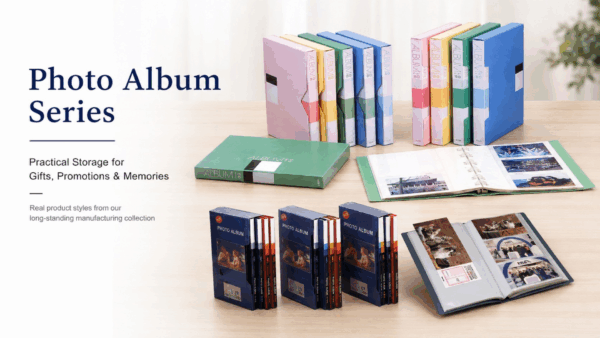
During the same period when our factory was producing file folders, clip files, refill pages and other document storage products, we also developed another important product category: photo albums.
At first glance, photo albums may seem different from office filing products. File folders are used for documents, while photo albums are used for pictures and memories. But from a manufacturing and sales perspective, they are closely connected.
Both products are built around the same idea: protecting important paper-based materials and presenting them in an organized way.
A file folder protects documents.
A refill page protects sheets.
A presentation book organizes visual materials.
A photo album protects photographs and presents memories.
The content changed, but the product logic remained the same.
Why Photo Albums Became a Strong Gift Product
Photo albums were especially suitable for gift and promotional markets because they carried emotional value.
A folder may be useful, but a photo album feels more personal. It can be used to store family photos, travel memories, school events, graduation pictures, company activities, wedding photos or brand campaign images.
This made the product more than a stationery item. It became a gift product.
For businesses, photo albums could be used as promotional gifts, event souvenirs or customer appreciation items. For schools, they could be used for graduation memories, class activities or student projects. For retailers, they were easy to sell because customers immediately understood the purpose.
From a Top Sales point of view, this was a very attractive category: practical enough for daily use, but emotional enough to be given as a gift.
A Product That Combined Function and Presentation
The strength of photo albums was that they combined protection, storage and display.
Photos needed to be protected from dust, scratches and bending. But users also wanted to view them easily. A well-made photo album allowed people to turn pages smoothly, organize photos by theme or event, and present memories in a complete format.
This made photo albums suitable for many use cases:
- family photo storage
- travel memories
- school graduation gifts
- company event souvenirs
- promotional giveaways
- wedding or celebration albums
- brand campaign gifts
- retail stationery products
Compared with loose photos, a photo album gave the content structure. It helped users keep memories together and made the presentation feel more complete.
That was the commercial value of the product.
Why Gift Buyers Liked This Product
Gift buyers often look for products that are useful, presentable and easy to customize. Photo albums matched these needs well.
They were not disposable items. People could keep them for a long time. They also had enough surface area for cover design, printing, branding, logos or special themes.
For companies, this meant the product could carry brand identity.
For schools, it could carry class or graduation memories.
For events, it could become a souvenir.
For retailers, it could be sold as a lifestyle stationery item.
This is why photo albums were commonly used in the gift market.
A good gift product should not only look nice when received. It should continue to be used afterward. Photo albums had that advantage because they were both meaningful and functional.
Customization Made Photo Albums More Marketable
D
Because our factory already had experience with PP materials, inner pages, binding structures and printing, photo albums became a natural extension of our production capability.
Different album sizes, page capacities, cover materials, colors and printing options allowed buyers to create products for different markets.
Some customers preferred simple and clean styles.
Some wanted colorful covers.
Some needed larger albums for family or travel photos.
Some wanted compact albums for promotional gifts.
Some required private label or OEM designs.
This flexibility made photo albums attractive for B2B customers.
From a sales perspective, customization was important because gift products often need to match a specific campaign, audience or brand image. A standard product can sell, but a customized product can become more memorable.
From Filing Products to Gift Stationery
Looking back, photo albums showed how our factory’s product line expanded from practical filing into gift stationery.
File folders answered the need for document organization.
Clip files answered the need for quick paper holding.
Refill pages answered the need for page protection.
Photo albums answered the need for memory storage and gift presentation.
Each product came from a different usage scenario, but they were all connected by one core idea: helping people protect and present something important.
That is why photo albums became a meaningful part of our product history.
They were practical products, but they also carried emotion. And in the gift market, that emotional value made them easier to promote.
Why This Product History Still Matters
Today, people store many photos on phones and cloud platforms. But physical photo albums still have value when the goal is to create something tangible, memorable and giftable.
For schools, events, brands and families, a printed photo placed inside an album feels different from an image stored in a phone. It becomes a keepsake.
For B2B buyers, this means photo albums can still be positioned as gift products, event products, school memory products or customized stationery products.
A product does not need to be complicated to have value. It needs to fit a real use case.
Photo albums did that well.
They helped users preserve memories, gave gift buyers a useful product option, and allowed brands or institutions to create something with long-term visibility.
Looking Back, Moving Forward
The development of photo albums was another important step in our factory’s product evolution.
From file folders to refill pages, from presentation books to photo albums, we continued to work with products that protect, organize and present paper-based content.
For us, photo albums were not just a separate gift item. They were part of the same manufacturing story: practical storage, clear presentation and customizable product development.
That is why this category still matters when we talk about our factory history.
It shows how a stationery manufacturer can move from office use to school use, from document protection to memory preservation, and from practical storage to gift-ready products.
Looking for Custom Photo Album Products?
We supply photo albums, presentation books, refill pages, file folders and related stationery storage products for gift buyers, schools, stationery retailers, event suppliers and B2B customers.
Custom sizes, cover designs, printing, page capacity, colors, OEM production and private label options are available based on your market needs.