
A Practical Product Category for Art Stores, School Suppliers and Creative Retailers
In today’s creative market, most artwork can be shared online through Behance, Instagram, PDF portfolios, or personal websites. Digital presentation is fast, convenient and widely accepted. However, for many art students, designers, architects, educators and creative professionals, physical presentation is still an essential part of their workflow.
When artwork needs to be reviewed in person, transported safely, organised for class, or presented during interviews and critiques, a digital file is not enough. Printed artwork, design boards, certificates, sketches and project documents still need a reliable way to be carried and protected.
This is where art portfolio bags and portfolio cases continue to play an important role.
For B2B buyers, this product should not be viewed as an old-fashioned accessory. It is a practical, repeatable and easy-to-understand product category for art supply stores, school suppliers, stationery distributors and creative retail channels.
Why Physical Presentation Still Has Market Demand
Digital portfolios are useful for first impressions, online applications and remote communication. But in many professional and educational situations, physical materials still carry value.
A printed portfolio allows reviewers to see paper texture, print quality, layout sequence, colour accuracy and presentation details more directly. In art schools, design interviews, classroom critiques, exhibitions and client meetings, physical work often creates a stronger sense of preparation and professionalism.
For the end user, a portfolio bag is not just something to carry artwork. It helps them arrive prepared.
For retailers, this creates a clear sales opportunity. The need is easy to explain: if customers carry artwork, drawings, design sheets or printed presentation materials, they need a product that keeps those materials flat, clean and organised.
From Simple Storage to Professional Presentation Support
A good portfolio bag does more than hold paper. It supports the entire presentation process.
Before a reviewer even looks at the artwork, the way the work is carried and presented already communicates something. A clean, structured portfolio case gives the impression of preparation, care and professional attitude.
Loose sheets, damaged corners or unorganised documents can weaken the presentation before the work is properly reviewed. This is especially important for students preparing for portfolio reviews, designers meeting clients, or artists attending evaluations.
For this reason, portfolio bags and cases should be positioned not only as storage products, but as presentation support tools.
Key Selling Point
A structured portfolio bag helps users protect their work, organise their materials and present with more confidence.
This is the message retailers and distributors should communicate clearly.
Mobility Is Now Part of Creative Work
Creative work is no longer limited to one studio or classroom. Students move between school, home and workshops. Designers meet clients in different locations. Architects carry drawings to meetings. Artists bring works-in-progress to critiques, exhibitions and evaluations.
In this mobile workflow, artwork needs to travel safely.
Portfolio bags act as practical mobile storage for creative materials. They allow users to move between locations without damaging or losing their work.
For B2B buyers, this is important because the product is not limited to one narrow user group. It can serve:
- Art students
- Design students
- Architecture students
- Teachers and educators
- Designers and illustrators
- Creative professionals
- Office users handling large-format documents
- Retail customers looking for practical document protection
This wide user base makes portfolio bags a stable and flexible product category.
Protection Is a Stronger Selling Point Than Decoration
In many product categories, colour and style help attract attention. But for portfolio bags, protection is often the main reason customers buy.
Artwork on paper can be easily damaged by bending, dust, moisture, fingerprints and friction. Large sheets are especially difficult to manage without a proper case.
A structured portfolio bag helps protect the work during transport and handling. Depending on the product design, it may include reinforced edges, water-resistant material, document pockets, elastic straps, zipper closure, hard board support, or lightweight construction.
For sales communication, the message should be simple:
The bag protects the work before the work is presented.
This is a strong and practical value proposition for both retail and institutional buyers.
Why Minimal Design Works Better for Professional Users
Many portfolio bags are designed in black or neutral colours for a reason. In professional and educational environments, the product should support the artwork, not compete with it.
A clean and simple design allows the focus to stay on the work inside. This is especially important for portfolio reviews, school interviews, client presentations and gallery-related use.
For retailers, black and neutral designs are also easier to sell across different age groups and user types. They work for students, teachers, designers, architects and office users.
However, colour options can still be useful for school supply channels, children’s art programs, promotional products, or retail markets that prefer brighter visual appeal.
This gives buyers two clear development directions:
Professional Line
Black, grey, navy or neutral colours for art schools, design users and professional presentation.
Retail / School Line
Brighter colours for younger users, school supplies, gift channels and creative retail stores.
Who Still Buys Portfolio Bags Today?
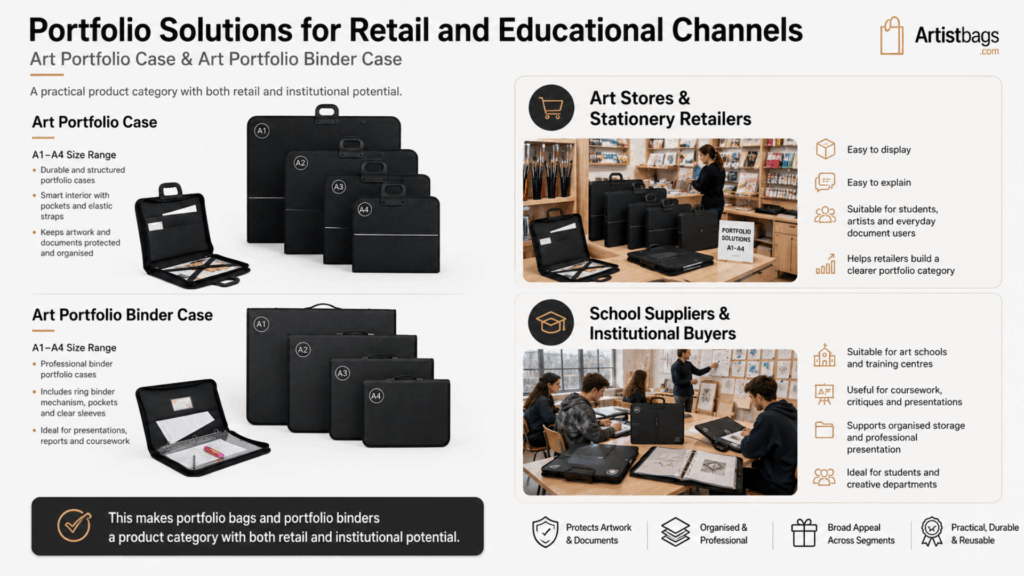
A strong product line should be built around real buyers, not just product features. Portfolio bags still have clear demand across several channels.
Art Students and Design Students
They need to carry drawings, coursework, presentation sheets, sketches, printed projects and portfolio materials.
Architecture and Design Users
They often work with larger sheets, design boards, layout prints and presentation documents.
Teachers and Educators
They may use portfolio cases to organise teaching materials, student work, certificates or classroom display items.
Creative Professionals
Designers, illustrators, photographers and artists may need a clean way to bring printed work to meetings or reviews.
Art Stores and Stationery Retailers
Retailers need products that are easy to display, easy to explain and useful to a wide customer base.
School Suppliers and Institutional Buyers
Schools and training centres may need practical portfolio solutions for students and creative departments.
This makes portfolio bags a product category with both retail and institutional potential.
Conclusion: A Quiet Product with Strong Practical Value
In the digital era, physical portfolio bags still matter because creative work still moves, gets reviewed, gets printed and gets presented in real life.
For end users, a portfolio bag protects artwork and supports professional presentation.
For retailers, it is a practical product that is easy to explain and easy to sell.
For school suppliers, it meets real educational and creative needs.
For OEM and private label buyers, it offers strong customisation potential across size, material, colour, interior design and branding.
A good portfolio bag does not need to be loud. Its value is in what it helps the user do: carry work safely, organise it clearly and present it with confidence.
That is why portfolio bags remain a useful and commercially relevant product category for art stores, school suppliers, creative retailers and international buyers.