
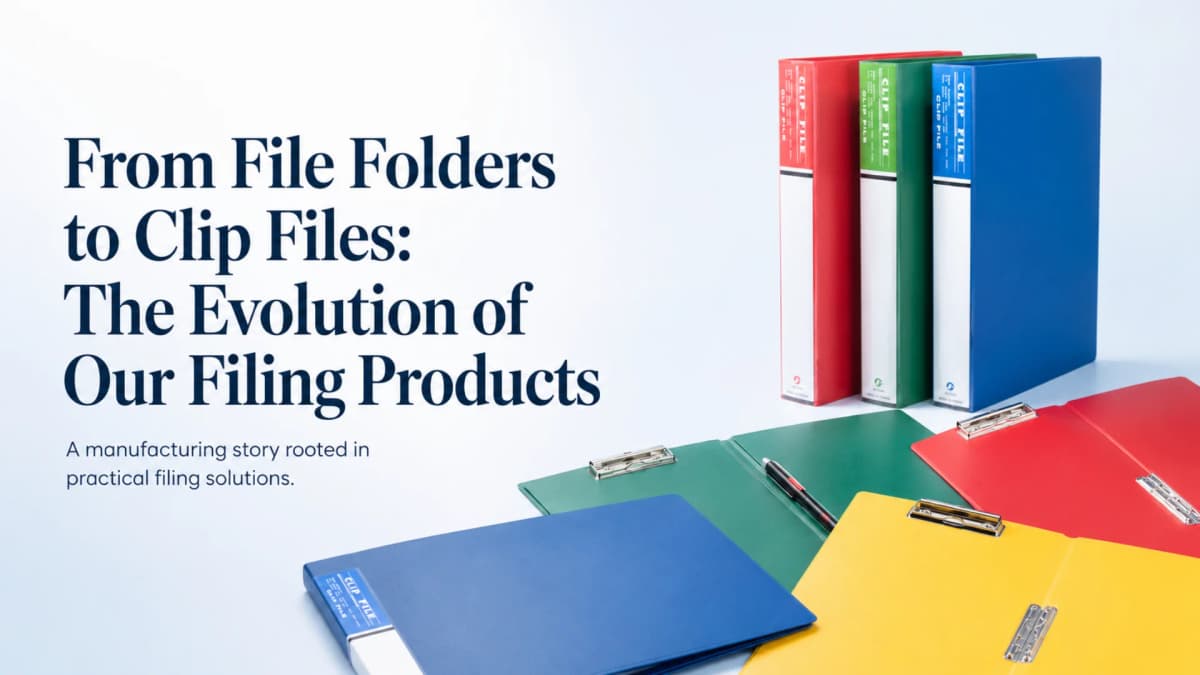
File folders and clip files, before digital storage: two of the most practical products a factory can make — solving the plain problem of organizing paper before cloud storage existed to do it instead.
Before tablets, laptops, cloud storage, and digital documents took over daily work, paper was the center of business, education, and communication. Offices ran on printed reports, contracts, quotation sheets, and catalogues. Schools ran on handouts, worksheets, and student records. Salespeople carried brochures and price lists on customer visits. Almost every industry needed a simple, reliable way to organize paper — and that's exactly when file folders and clip files became everyday essentials. Not luxury items. Practical tools that solved a problem common enough to sell well across offices, schools, stationery stores, and institutional channels alike.
The Early Role of File Folders
File folders did one job well: classify documents and keep them in order — by subject, customer, department, class, project, or date. For anyone handling paper every day, that small product cut down real confusion and made information findable.
There was no searching a file name on a computer back then, no cloud folder to open. Unsorted papers got lost, mixed up, or damaged — which made file folders necessary, not optional, for offices, schools, and administration work. The demand was broad by nature: companies, teachers, students, banks, government offices, training centers, stationery retailers. Simple product, genuinely large market.
Why Clip Files Became Popular
As people needed more convenient ways to hold and review documents, clip files stepped in with one key advantage: holding papers firmly in place without punching holes or extra binding. That made them useful for temporary documents, meeting notes, application forms, reports, classroom materials, and sales presentations.
Office workers used them to carry documents into meetings. Teachers used them for handouts and class records. Salespeople used them to present product sheets and quotations. Students used them to keep loose papers together. Simple, affordable, easy to use — in an era when paper moved constantly between desks, classrooms, and customers, a clip file was about as practical as a product gets.
Products That Sold Well Because They Matched the Era
These products look ordinary now, but they matched exactly how people worked at the time. No iPads for reading documents, no computer on every desk, no cloud storage, no digital catalogues — printed paper carried most communication, which made filing products part of the daily workflow, not an add-on.
A product sells well when it matches real user behavior, and file folders and clip files did that precisely: organize, carry, protect, present. Easy for retailers to display, easy for customers to understand, and built for repeated purchase — the combination that actually makes a product category last.
From Basic Filing to Product Evolution
These two products became the foundation for everything that came next. File folders pushed the market toward more structured document storage. Clip files showed the value of holding papers securely while presenting them neatly. What started in offices gradually expanded into schools, tutoring centers, institutions, events, and presentation use.
The products changed shape along the way. Side labels helped classify documents. Hot stamping added a more formal look. Black-and-white printing let schools and companies add names or basic information. Full-color PP printing eventually made folders genuinely attractive for branding, education, and promotional use. Even a simple filing product can grow with its market — the basic need stayed constant, but the product got more flexible, more visual, and more customizable around it.
Why This History Matters to Our Factory
File folders and clip files weren't just early products for us — they were part of the manufacturing foundation. Through them, we learned how customers actually use documents, how material thickness affects durability, and how cutting, folding, clipping, printing, and finishing all shape the final user experience.
That's the experience that later let us build display books, presentation books, portfolio cases, and art portfolio bags. The product forms kept changing. The core idea — organize it, protect it, present it clearly — never did.
Frequently Asked Questions
Why were file folders and clip files such strong sellers before digital storage?
Because paper was the primary way information moved, and both products solved the same real problem — organizing and protecting it — cheaply and reliably.
What's the practical difference between a file folder and a clip file?
A file folder classifies and stores documents long-term. A clip file holds papers firmly for something more temporary — meetings, presentations, handouts — without punching holes or binding.
How did these products lead to portfolio cases and presentation books?
The manufacturing lessons carried over directly — material handling, cutting, finishing — and the market's demand for more structured, presentable storage pushed the product line into display books, presentation books, and eventually portfolio cases.
Are file folders and clip files still relevant today?
Yes — schools, offices, and training centers still print materials and still need practical ways to organize and present them, even alongside digital tools.
Can these products be customized for wholesale or private label orders?
Yes — custom printing, OEM production, color options, and packaging support are all available based on the buyer's market.
Looking Ahead
Digital tools are everywhere now, but physical filing products still have their place — schools still print, offices still store, training centers still prepare handouts, companies still need presentation folders for meetings and events. The market changed. The value of practical organization didn't. From file folders to clip files, and from there into broader filing and presentation solutions, this evolution is really the story of how our factory grew alongside what users actually needed. We supply file folders, clip files, PP folders, presentation books, and related document storage products for stationery retailers, schools, tutoring centers, offices, and B2B buyers, with custom printing, OEM production, color options, and packaging support available based on your market.