
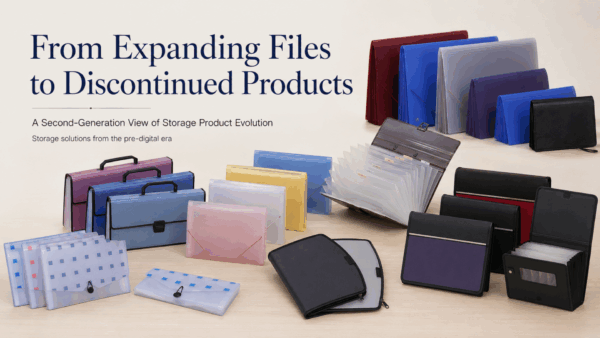
From Expanding Files to Discontinued Products: A Second-Generation View of Storage Product Evolution
Looking Back at a Product Era Built Around Storage
As a second-generation member of a stationery manufacturing family, I often look at old product photos with mixed feelings.
Some products were once strong sellers. Some helped support factory growth. Some were produced in many sizes, colors and structures. At the time, they were not considered “old products.” They were practical, useful and very much needed by the market.
Expanding files, document cases, accordion folders and multi-pocket organizers were part of that era.
These products were created for one clear purpose: storage.
Before digital files became common, people needed physical tools to organize paper. Offices used printed quotations, contracts, reports and forms. Schools used worksheets, notices and student records. Salespeople carried catalogues, price lists and customer documents. Families also kept certificates, receipts and important papers at home.
In that environment, document storage products were not optional. They were part of daily life.
The Rise of Expanding Files and Document Cases
Why Expanding Files Became Useful
Expanding files became popular because they solved a problem that simple folders could not fully handle.
A regular folder could hold documents, but when users had many categories, they needed something more structured. Expanding files provided separate compartments, allowing users to sort documents by subject, date, project, customer or department.
This made them especially useful for offices, schools, accountants, sales teams and administrative users.
From a sales perspective, the product was strong because the function was easy to understand. Customers could immediately see the value: more pockets, better classification, easier access.
The product did not need too much explanation. Once people opened it and saw the compartments, they understood why they needed it.
Why Document Cases Sold Well
Document cases also became popular because they added protection and portability.
Compared with a soft folder, a case gave documents more structure. Some designs included handles, closures, zippers or reinforced edges. This made them suitable for people who needed to carry documents outside the office or school.
For salespeople, document cases helped carry catalogues and customer files.
For students, they protected assignments and school papers.
For office workers, they made meetings and business visits more organized.
At that time, the product matched the working style of the market.
People moved with paper.
People presented with paper.
People stored information in paper form.
So the product had real demand.
A Product Line That Once Matched the Market Perfectly
Storage Was the Main Selling Point
Looking back, the strongest selling point of these products was very simple: they helped people keep things in order.
Some products were designed with many inner pockets.
Some had diagonal covers.
Some were transparent so users could quickly see the contents.
Some used handles for carrying.
Some were made with stronger covers to protect thicker documents.
Each detail came from a real usage need.
The product was not only about appearance. It was about solving problems:
How do I separate different documents?
How do I carry many papers without losing them?
How do I protect documents from bending?
How do I find what I need quickly?
These were everyday questions in the pre-digital office and school environment.
Why Buyers Continued to Order
For B2B buyers, expanding files and document cases were attractive because they could serve many channels.
Stationery stores could sell them to students and office users.
Wholesalers could supply them to schools and companies.
Corporate buyers could use them for internal document management.
Gift and promotional buyers could customize them for events or branded use.
This gave the product line strong commercial flexibility.
When a product can serve many customer groups, it becomes easier to sell, easier to reorder and easier to keep in a catalogue.
That was why these products had their own successful period.
When the Market Started to Change
Digital Tools Changed the Way People Stored Information
Like CD storage products, many document storage products were affected by a larger change: the way people stored information changed.
When computers became common, some documents moved from paper to files.
When email became common, fewer papers needed to be physically delivered.
When cloud storage appeared, people no longer needed to carry every document by hand.
When tablets and smartphones became part of work and study, more materials could be viewed digitally.
This did not happen overnight. But little by little, the need for certain physical storage products became smaller.
The product itself did not suddenly become bad.
The market simply changed.
That is an important lesson from a second-generation factory perspective.
Sometimes a product disappears not because it failed, but because the environment around it has changed.
Some Products Became Less Necessary
Expanding files and document cases were designed for a world with more paper.
When paper volume decreased, the demand naturally changed. Offices no longer needed as many large filing cases. Students carried fewer printed materials. Companies reduced physical catalogues. Many customers started using laptops, USB drives, shared folders and online documents.
The original problem these products solved became less urgent.
And when the problem changes, the product category also changes.
That is why some of these items are no longer part of our current product line.
They belonged to a specific period of market demand.
What These Discontinued Products Still Teach Us
A Good Product Must Match the Era
From a Top Sales point of view, these products were successful because they matched the era perfectly.
They solved a real problem.
They were easy to understand.
They were practical in daily use.
They could be sold across many channels.
They supported both individual users and institutional buyers.
That is what makes a product sell.
But the same product may not continue forever if the user behavior changes.
This is why product development cannot only focus on what sold well in the past. It must also observe how customers work, study, travel, store information and make purchase decisions today.
Manufacturing Experience Does Not Disappear
Even though some products are discontinued, the experience behind them remains valuable.
Through these products, our factory learned about structure, thickness, folding, closures, inner compartments, stitching, zipper processing, edge finishing and packaging.
These skills later helped us develop other products.
The knowledge from document cases can connect to portfolio cases.
The experience from expanding files can connect to organizers and storage bags.
The understanding of paper protection can connect to art portfolio products and presentation books.
So even if a product is no longer produced, it still becomes part of the factory’s technical foundation.
From Old Storage Products to New Product Directions
The Core Need Still Exists
Although some document storage products disappeared, the core need has not completely gone away.
People still need to organize things.
They still need to protect important materials.
They still need to carry items from one place to another.
They still need products that make daily work and study more convenient.
The difference is that the content has changed.
In the past, people carried more paper.
Today, people may carry laptops, tablets, cables, chargers, travel documents, art supplies or personal items.
This is why product evolution matters.
The old storage logic can still inspire new products, but the form must change with the user’s life.
Why This History Matters for Our Current Products
Today, when we develop art portfolio bags, presentation books, document folders, travel organizers or custom storage products, we are still using the same thinking:
What does the user need to protect?
How will they carry it?
How often will they use it?
Where will they store it?
Can the product be customized for different markets?
These questions come from years of manufacturing experience.
The product categories may change, but the discipline behind product development remains the same.
Final Thoughts
Expanding files, document cases and similar storage products were once important parts of our factory’s product history.
They remind us of a time when physical documents were everywhere, and storage products played a real role in daily business, school and office life. They also remind us that every product has its own market timing.
As a second-generation member of the factory, I do not see these discontinued products as failures. I see them as evidence of a period when our products truly met the needs of the market.
They helped users organize paper.
They helped buyers build product lines.
They helped our factory grow.
And they taught us how to observe demand.
Today, the market is different. But the lesson remains the same:
A good product is not only about what it is.
It is about whether it fits the way people live and work at that moment.
That is why we continue to look back at our old products, not only with nostalgia, but with respect. They were part of our manufacturing story, and they still guide how we think about product development today.
Looking for Practical Storage and Presentation Products?
We supply document folders, presentation books, portfolio cases, art portfolio bags and related storage products for schools, stationery retailers, art stores, distributors and B2B buyers.
While some traditional filing products have been discontinued, our experience in storage product manufacturing continues to support new product development, OEM projects and customized solutions for today’s market.