
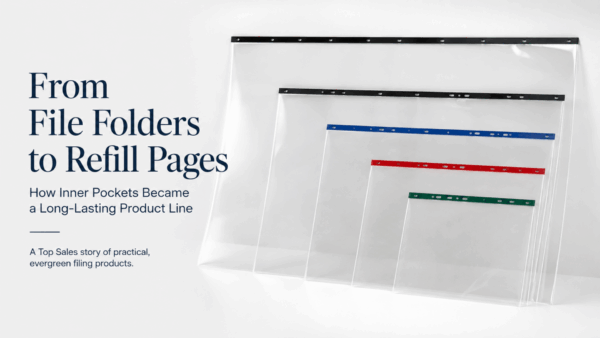
After file folders and clip files became widely used, the market started asking for something more flexible: inner pockets and refill pages.
This was a very natural product evolution.
A file folder helps users collect documents.
A clip file helps users hold papers in place.
But when users needed to organize more pages, protect individual sheets, turn pages easily, or build a complete presentation book, inner pockets became important.
That is how refill pages and clear inner pockets became part of our product line.
From a sales point of view, this is a very practical category. It may not look dramatic at first, but it solves a daily problem for many users: how to protect papers while keeping them easy to view, classify and replace.
Why Inner Pockets Became Necessary
As offices, schools, training centers and sales teams used more printed materials, people needed a better way to keep documents clean and organized.
Loose papers were easy to bend, stain, wrinkle or lose. File folders could hold documents together, but users still needed a way to separate pages and view them one by one. That is where refill pages became useful.
Each sheet could be placed inside a transparent pocket. Users could turn pages like a book, protect important documents, and replace pages when needed.
This made inner pockets suitable for many situations:
- office reports
- school handouts
- training materials
- price lists
- product catalogues
- certificates
- artwork samples
- presentation documents
The product was simple, but the usage was very wide.
Different Sizes Created More Selling Opportunities
One reason this product category stayed strong is that it could be made in different sizes.
Not every customer uses the same paper format. Some need A4 document pockets for office and school materials. Others need larger sizes for artwork, drawings, posters, samples or presentation sheets.
By offering different sizes, the product could serve more markets.
For stationery retailers, this created more shelf options.
For schools and institutions, it supported different document needs.
For art and design users, larger refill pages helped protect flat work.
For B2B buyers, size variation made the product easier to adapt to different customer groups.
This is one of the reasons refill pages became a long-lasting item. They are not limited to one user or one market.
Edge Strip Colors Helped Product Differentiation
At a later stage, even the edge strip became part of product development.
Originally, many inner pockets used simple black or basic edge strips. Later, different edge-strip colors were introduced. This helped buyers create more visual variety and gave users an easier way to classify documents.
For example, different colors could be used for different subjects, departments, projects, customers or product categories.
From a Top Sales perspective, this is a small detail with commercial value.
The core product did not need to change completely.
But by changing the edge strip color, the product became easier to sell as a series.
It gave retailers more options.
It gave customers more reasons to choose.
It gave wholesalers a broader product line to offer.
Sometimes product evolution does not come from a huge invention. It comes from improving a simple detail that users actually notice.
A Long-Lasting Product Because the Need Never Disappeared
Inner pockets and refill pages became evergreen products because the need behind them is stable.
People always need to protect important papers.
They need to organize pages.
They need to present documents clearly.
They need to replace or add pages when content changes.
Even today, when many materials are digital, physical documents still exist in schools, offices, exhibitions, sales meetings and creative reviews.
This is why refill pages remain useful.
They are not trend products.
They are support products.
And support products are often very important in B2B sales because they bring repeat demand. A customer may buy one presentation book, but they may continue buying refill pages. A school may purchase folders, but they also need extra inner pockets. A retailer may sell the main binder, and the refill pages become a related product that keeps the category alive.
From Filing Products to Presentation Systems
Looking back, our product development followed the real needs of the market.
First, customers needed file folders to organize documents.
Then they needed clip files to hold papers securely.
Later, they needed inner pockets and refill pages to protect and present individual sheets.
This development shows a clear direction: from simple storage to more complete presentation systems.
For our factory, these products were not separate items. They were connected.
The experience of producing file folders helped us understand materials and daily document use. The development of clip files helped us understand holding structure and user convenience. The production of refill pages helped us move deeper into page protection, size accuracy, edge sealing, punching holes and presentation book accessories.
These experiences later supported other product categories, including display books, presentation books, portfolio cases and art portfolio products.
Why This Product History Still Matters
For B2B buyers, a good product is not only about appearance. It must be practical, repeatable and easy to match with real market demand.
Inner pockets and refill pages meet these conditions.
They are easy to understand.
They can be sold with folders and presentation books.
They support different sizes and applications.
They can be customized by edge strip, hole position, thickness and packaging.
They are useful for schools, offices, art users and institutional buyers.
That is why this category has remained valuable for many years.
From a Top Sales point of view, this is exactly the kind of product that builds long-term business: not loud, not complicated, but always needed.
Looking Back, Moving Forward
The inner pocket and refill page category is part of our factory’s product evolution.
From file folders to clip files, and from clip files to refill pages, each stage came from real customer demand. These products helped users organize, protect and present documents more efficiently, and they also helped our factory build deeper manufacturing experience.
Different sizes, different edge-strip colors, different materials and different hole designs all became part of this development.
They may look simple, but they represent years of practical production knowledge.
And for us, that is the value of a long-lasting product: it continues to serve users because the need behind it has never disappeared.
Looking for Refill Pages and Document Pocket Solutions?
We supply refill pages, inner pockets, sheet protectors, file folders, clip files, presentation books and related document storage products for stationery retailers, schools, offices, art stores and B2B buyers.
Custom sizes, edge-strip colors, hole positions, material thickness and packaging options are available based on your market needs.